How mosquitoes could teach us a trick in the fight against malaria
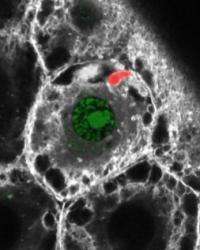
(PhysOrg.com) -- The means by which most deadly malaria parasites are detected and killed by the mosquitoes that carry them is revealed for the first time in research published today in Science Express. The discovery could help researchers find a way to block transmission of the disease from mosquitoes to humans.
Mosquitoes become infected with malaria when they feed on the blood of an infected person. Young malaria parasites then grow and develop inside the mosquito for two weeks. New human infections occur when these parasites are 'injected' with the insect's saliva during the mosquito's next blood meal.
However, most of the malaria parasites are killed by the mosquito's immune system as soon as they enter the insect's bloodstream, with only one or two slipping through the net and going on to divide, multiply, and infect people.
The new study shows exactly how the mosquito's immune system kicks in to kill 80 - 90 percent of the parasites. The researchers discovered that the parasites are detected by a pair of proteins called LRIM1 and APL1C which belong to the mosquito's infection surveillance system. These two 'intruder detection' proteins then activate a third protein in the mosquito's blood called TEP1, which seeks out the parasitic invader, binds to its surface and orchestrates its destruction by punching holes in its cell membrane.
The Imperial College London team behind the new discovery say this knowledge could be used to develop new genetic or chemical techniques to improve on the mosquito's natural detection success rate, so that 100 percent of the parasites can be killed inside the mosquito, preventing transmission of the disease from insects to people.
Dr George Christophides from Imperial's Department of Life Sciences comments: "Mosquitoes are known as the 'bad guys' that spread malaria, but these insects are unwilling carriers of the disease, whose immune systems try to fight it, just like ours do. Now that we know exactly how their immune system attacks malaria parasites, we need to work out how a small number of parasites manage to evade detection by this system. Only a few manage to get past the mosquito's defences, but that's all that's needed for the disease to be transmitted to humans.
"If we can figure out how some parasites manage to sneak through undetected, hopefully we can find a way to bolster the mosquito's defences to catch them all."
The research, which was funded by the Wellcome Trust, the Biotechnology and Biological Sciences Research Council (BBSRC), and the National Institute of Allergy and Infectious Diseases of the U.S. National Institutes of Health, was carried out in the laboratory using a model parasite which causes malaria in rodents.
Half the global population are at risk of contracting malaria and up to half a billion new infections are recorded every year. Between one and three million people die from malaria every year - the majority of fatalities are children living in sub-Saharan Africa.
Apart from malaria, mosquitoes also spread other serious infectious diseases such as dengue and yellow fever, filariasis and various encephalitides. Dr Christophides and his colleagues at Imperial also discovered that LRIM1 and APL1C belong to a family of infection detection proteins that appear to be specific to mosquitoes. The researchers believe that proteins in this family may play a role in defence against these other infections too, and are currently investigating how these proteins function during mosquito infection with dangerous human pathogens.
Source: Imperial College London


