Japan astronaut to try flying carpet in space lab: official
Mar 05, 2009
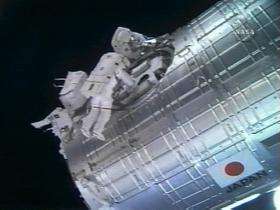
File photo shows astronauts working on The International Space Station's Japanese Kibo module. A Japanese astronaut going to space this month will try to fly on a carpet, use eyedrops in zero gravity and meet a series of other off-beat challenges, a space agency official said Thursday. Wakata will try "a magic carpet that floats in the air" after he reaches the laboratory Kibo.

A Japanese astronaut going to space this month will try to fly on a carpet, use eyedrops in zero gravity and meet a series of other off-beat challenges, a space agency official said Thursday.

Koichi Wakata will perform 16 tasks chosen from 1,597 suggested by hundreds of people, from nursery school pupils to a 90-year-old man, said the official at the Japan Aerospace Exploration Agency (JAXA).

Wakata will try "a magic carpet that floats in the air" after he reaches the Japanese laboratory Kibo (Hope) at the International Space Station (ISS) later in March for a stay of more than three months, said a JAXA report.

"It is a fantasy on earth but can humans fly in space?" it asked.

Wakata will also attempt to fold clothes, do push-ups and backflips, arm-wrestle another astronaut and "shoot liquid out of the straw of a drink container to see what happens", said the space agency.

JAXA said it would release footage of the experiments to Japanese media.

Wakata, a 45-year-old former Japan Airlines engineer, joined previous NASA space shuttle missions in 1996 and 2000.

On his first space trip he and a fellow astronaut became the first to play the board game Go in space, using a special set.

In another initiative, the Japanese space agency has invited companies to rent an astronaut by the hour in the ISS space lab to perform desired tasks, which could include advertisements or science experiments.

The hourly charge for an astronaut is 5.5 million yen (55,000 dollars) -- plus an extra fee to transport any required items into space of 3.3 million yen per kilogramme (1.5 million yen per pound).

(c) 2009 AFP

Explore further: Dark, massive asteroid to fly by Earth on May 31

add to favorites email to friend print save as pdf

Related Stories

Japan probe overshoots Venus, heads toward sun

Dec 08, 2010

A Japanese probe to Venus failed to reach orbit Wednesday and was captured by the sun's gravitational pull in a setback to Japan's shoestring space program, which will have to wait another six years to try again. ...

Japan cargo spacecraft docks at ISS

Sep 18, 2009

Japan's first cargo spacecraft arrived at the International Space Station (ISS) on Friday after astronauts aboard the station grabbed and docked it using a robotic arm.

Japan sends first cargo spacecraft to ISS

Sep 11, 2009

Japan on Friday launched its first unmanned cargo spacecraft to the International Space Station, aiming for a share of space transport after the retirement of the US space shuttle fleet next year.

Japan sends first cargo spacecraft to ISS

Sep 10, 2009

Japan early Friday launched its first cargo spacecraft to the International Space Station, aiming for a share of space transport after the retirement of the US space shuttle fleet next year.

Recommended for you

Dark, massive asteroid to fly by Earth on May 31

6 hours ago

It's 1.7 miles long. Its surface is covered in a sticky black substance similar to the gunk at the bottom of a barbecue. If it impacted Earth it would probably result in global extinction. Good thing it is ...

Research team explains 'Lazarus' comets

9 hours ago

Astronomers from the University of Antioquia have discovered a graveyard of comets. These once-dormant comets, dubbed by astronomers as "The Lazarus comets," are now rejuvenated.

NASA ships sensors for seafaring satellite to France

10 hours ago

(Phys.org) —Three NASA-built instruments that are integral components of the next in a series of U.S./European ocean altimetry satellites have arrived in France for integration with their spacecraft in ...

Trip into space with DiCaprio costs $1.55m

10 hours ago

Leonardo DiCaprio is going to get closer to stars of a different kind as he heads into space aboard the Virgin Galactic, and a well-heeled bidder at the Cannes Film Festival has paid 1.2 million euros (1.5 million) to be ...

User comments : 11

Adjust slider to filter visible comments by rank

Display comments: newest first

mvg
not rated yet Mar 05, 2009
Your tax dollars at work.
Hungry4info2
not rated yet Mar 05, 2009
Actually... it's a JAXA operation, so it isn't OUR tax dollars.
DGBEACH
5 / 5 (1) Mar 05, 2009
Next they'll be dragging giant illuminated advertising bill-boards behind the ship for all to see.
Modernmystic
5 / 5 (1) Mar 05, 2009
Actually... it's a JAXA operation, so it isn't OUR tax dollars.


How's he getting into space?
1664
5 / 5 (3) Mar 05, 2009
Actually... it's a JAXA operation, so it isn't OUR tax dollars.


How's he getting into space?


On his magic carpet of course
Husky
not rated yet Mar 05, 2009
tax dollars at work, but not working very hard
JeanPierreSarti
4.3 / 5 (4) Mar 06, 2009
To be honest you people are being grumble pots. yes the experiments are silly but i think the space agencies do not do enough to inspire lay people to support space exploration or research. all we hear about is a bunch of billion dollar satellites for a few physicists here or there to do their esoteric experiments or spy satellites that do god knows what.

it is bad enough that most of our kids want to either be a pop princess or a professional athlete. Things like this can only help inspire people, in its own little way, to either go into science or support it.
Modernmystic
4.3 / 5 (3) Mar 06, 2009
To be honest you people are being grumble pots. yes the experiments are silly but i think the space agencies do not do enough to inspire lay people to support space exploration or research. all we hear about is a bunch of billion dollar satellites for a few physicists here or there to do their esoteric experiments or spy satellites that do god knows what.

it is bad enough that most of our kids want to either be a pop princess or a professional athlete. Things like this can only help inspire people, in its own little way, to either go into science or support it.


Doing idiotic stunts isn't going to inspire anyone.

You want to inspire people, fire up the manned exploration stuff again. Quit playing patty cake in LEO with a highly over rated erector set and START EXPLORING again....
nkalanaga
not rated yet Mar 06, 2009
I'd love too, but:

Where do we go? and,
How do we pay for it?

Modernmystic
not rated yet Mar 06, 2009
I'd love too, but:

Where do we go? and,
How do we pay for it?


If I actually have to answer either of those questions for you, then you're definately not going to understand them...
nkalanaga
5 / 5 (1) Mar 08, 2009
Oh, I'd understand them. But the only two ways to pay for space exploration is public or private money. To get the public to pay, you have to convince that public to pay taxes to support the program. To get private money, you need either some VERY rich space enthusiasts, or corporations who see a profit in it. So I ask again, "How do we pay for it?" Exxon might be able to afford to send a manned mission to Mars, and there are a few individuals who could pool their resources to do it, but neither have an incentive. The taxpayers, especially in the current economic climate, are unlikely to support more taxes, unless there is clear evidence of a benefit TO THEM.

As for "Where do we go?", that may be an even more important question. Before we can start raising money, we need a destination. Right now, the logical choices would be the Moon, Mars, or the asteroids. We can't afford to send people to all three at the same time, starting from scratch. So, which will it be? All have advantages, and all have disadvantages.

Given the amount of hydrocarbons there, you might be able to talk Exxon into funding a mission to Titan! Never mind the battleships and tramp freighters of sci-fi, the first large-scale space commerce could be oil tankers...

More news stories

Galaxies fed by funnels of fuel

(Phys.org) —Computer simulations of galaxies growing over billions of years have revealed a likely scenario for how they feed: a cosmic version of swirly straws.

Dark, massive asteroid to fly by Earth on May 31

It's 1.7 miles long. Its surface is covered in a sticky black substance similar to the gunk at the bottom of a barbecue. If it impacted Earth it would probably result in global extinction. Good thing it is ...

Source of life running out: water scientists

The majority of people on Earth people will face severe water shortages within a generation or two if pollution and waste continues unabated, scientists warned at a conference in Bonn Friday.

Google eyes emerging markets networks

Google has become deeply involved in a series of projects to build and operate wireless networks in emerging markets including sub-Saharan Africa and Southeast Asia, a report said Friday.

Facial-recognition technology proves its mettle

(Phys.org) —In a study that evaluated some of the latest in automatic facial recognition technology, researchers at Michigan State University were able to quickly identify one of the Boston Marathon bombing ...