Saturn has small moon hidden in ring
Mar 03, 2009
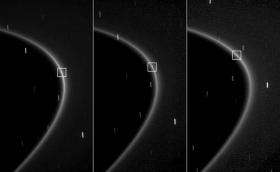
This sequence of three images, obtained by NASA's Cassini spacecraft over the course of about 10 minutes, shows the path of a newly found moonlet in a bright arc of Saturn's faint G ring. Image credit: NASA/JPL/Space Science Institute

(PhysOrg.com) -- NASA's Cassini spacecraft has found within Saturn's G ring an embedded moonlet that appears as a faint, moving pinprick of light. Scientists believe it is a main source of the G ring and its single ring arc.

Cassini imaging scientists analyzing images acquired over the course of about 600 days found the tiny moonlet, half a kilometer (about a third of a mile) across, embedded within a partial ring, or ring arc, previously found by Cassini in Saturn’s tenuous G ring.

The finding is being announced today in an International Astronomical Union circular.

“Before Cassini, the G ring was the only dusty ring that was not clearly associated with a known moon, which made it odd,” said Matthew Hedman, a Cassini imaging team associate at Cornell University in Ithaca, N.Y. “The discovery of this moonlet, together with other Cassini data, should help us make sense of this previously mysterious ring.”

Saturn’s rings were named in the order they were discovered. Working outward they are: D, C, B, A, F, G and E. The G ring is one of the outer diffuse rings. Within the faint G ring there is a relatively bright and narrow, 250-kilometer-wide (150-miles) arc of ring material, which extends 150,000 kilometers (90,000 miles), or one-sixth of the way around the ring’s circumference. The moonlet moves within this ring arc. Previous Cassini plasma and dust measurements indicated that this partial ring may be produced from relatively large, icy particles embedded within the arc, such as this moonlet.

Scientists imaged the moonlet on Aug. 15, 2008, and then they confirmed its presence by finding it in two earlier images. They have since seen the moonlet on multiple occasions, most recently on Feb. 20, 2009. The moonlet is too small to be resolved by Cassini’s cameras, so its size cannot be measured directly. However, Cassini scientists estimated the moonlet’s size by comparing its brightness to another small Saturnian moon, Pallene.

Hedman and his collaborators also have found that the moonlet’s orbit is being disturbed by the larger, nearby moon Mimas, which is responsible for keeping the ring arc together.

This brings the number of Saturnian ring arcs with embedded moonlets found by Cassini to three. The new moonlet may not be alone in the G ring arc. Previous measurements with other Cassini instruments implied the existence of a population of particles, possibly ranging in size from 1 to 100 meters (about three to several hundred feet) across. “Meteoroid impacts into, and collisions among, these bodies and the moonlet could liberate dust to form the arc,” said Hedman.

Carl Murray, a Cassini imaging team member and professor at Queen Mary, University of London, said, "The moon's discovery and the disturbance of its trajectory by the neighboring moon Mimas highlight the close association between moons and rings that we see throughout the Saturn system. Hopefully, we will learn in the future more about how such arcs form and interact with their parent bodies."

Early next year, Cassini’s camera will take a closer look at the arc and the moonlet. The Cassini Equinox mission, an extension of the original four-year mission, is expected to continue until fall of 2010.

Provided by NASA

Explore further: NASA's STEREO detects a CME from the sun

add to favorites email to friend print save as pdf

Related Stories

Saturn's little wavemaking moon

Apr 25, 2013

Captured on January 15, this narrow-angle Cassini image shows an outer portion of Saturn's A ring on the left and the ropy F ring crossing on the right. The thin black line near the A ring's bright edge is ...

Solar eclipse to sweep across Australia, Pacific Islands

Apr 30, 2013

An annular eclipse of the Sun, when a ring of everyday Sun remains around the Moon's silhouette, will sweep across the Australian outback and into the Pacific Ocean on the morning of May 10, local time. Though ...

Cassini observes meteors colliding with Saturn's rings

Apr 25, 2013

(Phys.org) —NASA's Cassini spacecraft has provided the first direct evidence of small meteoroids breaking into streams of rubble and crashing into Saturn's rings. These observations make Saturn's rings ...

Recommended for you

Mars rover Opportunity examines clay clues in rock

9 hours ago

(Phys.org) —NASA's senior Mars rover, Opportunity, is driving to a new study area after a dramatic finish to 20 months on "Cape York" with examination of a rock intensely altered by water.

NASA's STEREO detects a CME from the sun

22 hours ago

On 5:24 a.m. EDT on May 17, 2013, the sun erupted with an Earth-directed coronal mass ejection or CME, a solar phenomenon that can send billions of tons of solar particles into space that can reach Earth ...

Nine-year-old Mars rover passes 40-year-old record

May 17, 2013

While Apollo 17 astronauts Eugene Cernan and Harrison Schmitt visited Earth's moon for three days in December 1972, they drove their mission's Lunar Roving Vehicle 19.3 nautical miles (22.210 statute miles ...

Bright explosion on the Moon

May 17, 2013

For the past 8 years, NASA astronomers have been monitoring the Moon for signs of explosions caused by meteoroids hitting the lunar surface. "Lunar meteor showers" have turned out to be more common than anyone ...

User comments : 0

More news stories

Galaxy's Ring of Fire

Johnny Cash may have preferred this galaxy's burning ring of fire to the one he sang about falling into in his popular song. The "starburst ring" seen at center in red and yellow hues is not the product of ...

Alaska volcano shoots ash 15,000 feet into the air

(AP)—One of Alaska's most restless volcanoes has shot an ash cloud 15,000 feet into the air in an ongoing eruption that has drawn attention from a nearby community but isn't expected to threaten air traffic.

Chinese, Indian airlines face EU pollution fines

Eight Chinese and two Indian airlines face fines of up to several million euros for not paying for their greenhouse gas emissions during flights within the bloc, the European Commission said on Friday.

Morocco to harness the wind in energy hunt

Morocco is ploughing ahead with a programme to boost wind energy production, particularly in the southern Tarfaya region, where Africa's largest wind farm is set to open in 2014.

US psychiatry gets makeover in new manual

The latest makeover to a massive psychiatric tome honored by some, reviled by others and even called the "Bible" of mental disorders is being released Saturday with a host of new changes.