Stars forced to relocate near the Southern Fish
Mar 03, 2009
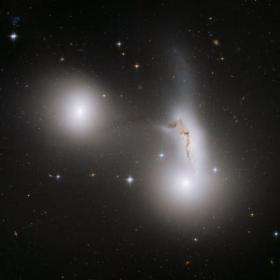
The three pictured galaxies -- NGC 7173 (middle left), NCG 7174 (middle right) and NGC 7176 (lower right) -- are part of the Hickson Compact Group 90, named after astronomer Paul Hickson, who first catalogued these small clusters of galaxies in the 1980s. NGC 7173 and NGC 7176 appear to be smooth, normal elliptical galaxies without much gas and dust. In stark contrast, NGC 7174 is a mangled spiral galaxy, barely clinging to independent existence as it is ripped apart by its close neighbors. The strong tidal interaction surging through the galaxies has dragged a significant number of stars away from their home galaxies. These stars are now spread out, forming a tenuous luminous component in the galaxy group. Credit: NASA, ESA and R. Sharples (University of Durham, U.K.)

About 100 million light-years away, in the constellation of Piscis Austrinus (the Southern Fish), three galaxies are playing a game of gravitational give-and-take that might ultimately lead to their merger into one enormous entity.

A new image from the Advanced Camera for Surveys on the NASA/ESA Hubble Space Telescope allows astronomers to view the movement of gases from galaxy to galaxy, revealing the intricate interplay among them.

The three pictured galaxies — NGC 7173 (middle left), NCG 7174 (middle right) and NGC 7176 (lower right) — are part of the Hickson Compact Group 90, named after astronomer Paul Hickson, who first catalogued these small clusters of galaxies in the 1980s. NGC 7173 and NGC 7176 appear to be smooth, normal elliptical galaxies without much gas and dust.

In stark contrast, NGC 7174 is a mangled spiral galaxy, barely clinging to independent existence as it is ripped apart by its close neighbours. The strong tidal interaction surging through the galaxies has dragged a significant number of stars away from their home galaxies. These stars are now spread out, forming a tenuous luminous component in the galaxy group.

Ultimately, astronomers believe that the stars in NGC 7174 will be redistributed into a giant 'island universe', tens to hundreds of times as massive as our own Milky Way.

Source: ESA/Hubble Information Centre

Explore further: Galaxy's Ring of Fire

add to favorites email to friend print save as pdf

Related Stories

Hubble tells a tale of galactic collisions

May 13, 2013

(Phys.org) —When we look into the distant cosmos, the great majority of the objects we see are galaxies: immense gatherings of stars, planets, gas, dust, and dark matter, showing up in all kind of shapes. ...

Thermal shield testing on Webb's MIRI

May 09, 2013

(Phys.org) —NASA engineer Acey Herrera recently checked out copper test wires inside the thermal shield of the Mid-Infrared Instrument, known as MIRI, that will fly aboard NASA's James Webb Space Telescope. ...

Sifting through the atmospheres of far-off worlds

May 09, 2013

(Phys.org) —Gone are the days of being able to count the number of known planets on your fingers. Today, there are more than 800 confirmed exoplanets—planets that orbit stars beyond our sun—and more ...

Recommended for you

Galaxy's Ring of Fire

May 18, 2013

Johnny Cash may have preferred this galaxy's burning ring of fire to the one he sang about falling into in his popular song. The "starburst ring" seen at center in red and yellow hues is not the product of ...

4C+29.30: Black hole powered jets plow into galaxy

May 15, 2013

(Phys.org) —This composite image of a galaxy illustrates how the intense gravity of a supermassive black hole can be tapped to generate immense power. The image contains X-ray data from NASA's Chandra X-ray ...

A space-time magnifying glass

May 15, 2013

(Phys.org) —Bright arcs are smeared around the heart of galaxy cluster Abell S1077 in this image taken by the NASA/ESA Hubble space telescope. The arcs are stretched images of distant galaxies distorted ...

User comments : 0

More news stories

Bold action, big money needed to curb Asia floods

Asia's flood-prone megacities should fund major drainage, water recycling and waste reduction projects to stem deluges and secure clean supply for their booming populations, experts said Sunday.

Heat-related deaths in Manhattan projected to rise

Residents of Manhattan will not just sweat harder from rising temperatures in the future, says a new study; many may die. Researchers say deaths linked to warming climate may rise some 20 percent by the 2020s, ...

Mice, gerbils perish in Russia space flight

A number of mice and eight gerbils sent into space in a Russian capsule destined to find out how well organisms can withstand extended flights perished during their journey, scientists said Sunday as the ...