New clues about mitochondrial 'growth spurts'
Mar 02, 2009
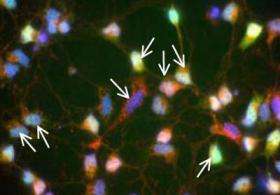
The arrows mark fusing mitochondria in Bcl-xL-lacking cells. Credit: Berman, S.B., et al. 2009. J. Cell Biol. doi:10.1083/jcb.200809060.

Mitochondria are restless, continually merging and splitting. But contrary to conventional wisdom, the size of these organelles depends on more than fusion and fission, as Berman et al. show. Mitochondrial growth and degradation are also part of the equation.

The study will appear online March 2, 2009 and in the March 9, 2009 print issue of The Journal of Cell Biology (JCB).

Fission is necessary to produce new mitochondria, such as those that power synaptic activity in healthy neurons. Fusion is also important. It goes awry in one form of Charcot-Marie-Tooth disease, in which peripheral nerves deteriorate, and in other neurodegenerative diseases. How cells manage mitochondrial size and number remains unclear.

Berman et al. found a clue when they started refining measurements of mitochondrial dynamics. The team labeled the organelles with a red fluorescent protein and a light-activated green fluorescent protein. By switching on the green marker with a laser and then looking for the mixing of colors, the researchers could distinguish mitochondrial mergers from near misses. To their surprise, they found that in healthy neurons, fission occurs up to six times more often than fusion.

So why aren't the cells cluttered with tiny mitochondria? Because the organelles grow longer, the researchers determined. This size increase offsets the higher fission rate. The researchers also surmised that to "balance the books," another process has to be operating—mitochondrial degradation. Together, fusion, fission, growth, and breakdown determine mitochondrial size and shape, Berman et al. propose.

Orchestrating many of these changes is the protein Bcl-xL. The team found that it spurred mitochondrial elongation and sped up fission and fusion. Without Bcl-xL, mitochondria became stumpy and seemingly less energy efficient. Bcl-xL belongs to the Bcl-2 protein family, whose members can protect mitochondria or shatter them to drive apoptosis. Berman et al.'s results suggest that Bcl-xL manages the number, size, and energy-producing capacity of mitochondria long before the cell is faced with a life-or-death decision. Still a mystery, the scientists say, is how Bcl-xL sparks mitochondrial growth.

More information: Berman, S.B., et al. 2009. J. Cell Biol. doi:10.1083/jcb.200809060. www.jcb.org

Source: Rockefeller University Press

Explore further: X-ray tomography on a living frog embryo

add to favorites email to friend print save as pdf

Related Stories

Yahoo unveils makeover of Flickr site

3 hours ago

Reinvigorated technology player Yahoo! Monday unveiled a dusted-off design of its flickr photo platform only hours after the company's dramatic acquisition of blogging site Tumblr. ...

Recommended for you

Intestinal bacteria protect against E. coli O157:H7

12 hours ago

A cocktail of non-pathogenic bacteria naturally occurring in the digestive tract of healthy humans can protect against a potentially lethal E. coli infection in animal models according to research presented today at the 11 ...

Explainer: What are stem cells?

18 hours ago

In a paper published in Cell yesterday, scientists from the US and Thailand have, for the first time, successfully produced embryonic stem cells from human skin cells. ...

Cattle disease bacteria widespread in the UK

19 hours ago

A new study has found that bacteria responsible for chronic intestinal inflammation in cattle, which have also been implicated in Crohn's disease in humans, are widespread in the UK countryside.

Mapping a route to stem cell therapies

20 hours ago

Monash University researchers are shedding light on the complex processes that underpin the creation and differentiation of stem cells, bringing closer the promise of 'miracle' therapies.

X-ray tomography on a living frog embryo

May 16, 2013

Classical X-ray radiographs provide information about internal, absorptive structures of organisms such as bones. Alternatively, X-rays can also image soft tissues throughout early embryonic development of ...

User comments : 0

More news stories

New immune system discovered

(Medical Xpress)—A research team, led by Jeremy Barr, a biology post-doctoral fellow, unveils a new immune system that protects humans and animals from infection.

Lab sets a new record for creating heralded photons

(Phys.org) —Entanglement, by general consensus of physicists, is the weirdest part of quantum science. To say that two particles, A and B, are entangled means that they are actually two parts of an inseparable ...

Protein study suggests drug side effects are inevitable

A new study of both computer-created and natural proteins suggests that the number of unique pockets – sites where small molecule pharmaceutical compounds can bind to proteins – is surprisingly small, meaning drug side ...