Two food additives with previously unrecognized estrogen-like effects in two food additives
Mar 02, 2009
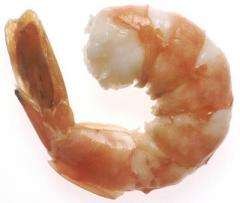
Scientists have identified two food additives with previously unrecognized estrogen-like effects. One of the additives, 4-hexylresorcinol, is used to prevent discoloration in shrimp and other shellfish. Image: National Cancer Institute, Renee Comet

Scientists in Italy are reporting development and successful use of a fast new method to identify food additives that act as so-called "xenoestrogens" — substances with estrogen-like effects that are stirring international health concerns. They used the method in a large-scale screening of additives that discovered two additives with previously unrecognized xenoestrogen effects. Their report appears in the current edition of ACS' Chemical Research in Toxicology.

In the study, Pietro Cozzini and colleagues cite increasing concern about identifying these substances and about the possible health effects. Synthetic chemicals that mimic natural estrogens (called "xenoestrogens," literally, "foreign estrogens") have been linked to a range of human health effects. They range from reduced sperm counts in men to an increased risk of breast cancer in women.

The scientists used the new method to search a food additive database of 1,500 substances, and verified that the method could identify xenoestrogens. In the course of that work, they identified two previous unrecognized xenoestrogens. One was propyl gallate, a preservative used to prevent fats and oils from spoiling. The other was 4-hexylresorcinol, used to prevent discoloration in shrimp and other shellfish. "Some caution should be issued for the use of propyl gallate and 4-hexylresocrinol as food additives," they recommend in the study.

More information: "Identification of Xenoestrogens in Food Additives by an Integrated in Silico and In Vivo Approach", Chemical Research in Toxicology

Provided by ACS

Explore further: Method developed for adding omega-3 fatty acids to foods

add to favorites email to friend print save as pdf

Related Stories

Icy Arctic rising as economic, security hot spot

May 11, 2013

The icy Arctic is emerging as a global economic hot spot—and one that is becoming a security concern for the U.S. as world powers jockey to tap its vast energy resources and stake out unclaimed territories.

Olive oil assays may help assure authenticity

May 10, 2013

Though the price makes you wince, you might just buy that bottle of your favorite olive oil anyway. Perhaps it's exactly what you want for the salad dressing you're making tonight and for your special stir-fry ...

Recommended for you

Non-wetting fabric drains sweat

7 hours ago

(Phys.org) —Waterproof fabrics that whisk away sweat could be the latest application of microfluidic technology developed by bioengineers at the University of California, Davis.

Protein study suggests drug side effects are inevitable

9 hours ago

A new study of both computer-created and natural proteins suggests that the number of unique pockets – sites where small molecule pharmaceutical compounds can bind to proteins – is surprisingly small, meaning drug side ...

Attacking MRSA with metals from antibacterial clays

May 17, 2013

In the race to protect society from infectious microbes, the bugs are outrunning us. The need for new therapeutic agents is acute, given the emergence of novel pathogens as well as old foes bearing heightened antibiotic resistance.

Beautiful 'flowers' self-assemble in a beaker

May 16, 2013

By simply manipulating chemical gradients in a beaker of fluid, materials scientists at Harvard have found that they can control the growth behavior of crystals to create precisely tailored structures—such ...

User comments : 0

More news stories

Protein study suggests drug side effects are inevitable

A new study of both computer-created and natural proteins suggests that the number of unique pockets – sites where small molecule pharmaceutical compounds can bind to proteins – is surprisingly small, meaning drug side ...

Non-wetting fabric drains sweat

(Phys.org) —Waterproof fabrics that whisk away sweat could be the latest application of microfluidic technology developed by bioengineers at the University of California, Davis.

Beautiful 'flowers' self-assemble in a beaker

By simply manipulating chemical gradients in a beaker of fluid, materials scientists at Harvard have found that they can control the growth behavior of crystals to create precisely tailored structures—such ...

Attacking MRSA with metals from antibacterial clays

In the race to protect society from infectious microbes, the bugs are outrunning us. The need for new therapeutic agents is acute, given the emergence of novel pathogens as well as old foes bearing heightened antibiotic resistance.

Lab sets a new record for creating heralded photons

(Phys.org) —Entanglement, by general consensus of physicists, is the weirdest part of quantum science. To say that two particles, A and B, are entangled means that they are actually two parts of an inseparable ...

Do salamanders hold the solution to regeneration?

Salamanders' immune systems are key to their remarkable ability to regrow limbs, and could also underpin their ability to regenerate spinal cords, brain tissue and even parts of their hearts, scientists have ...