Cassini Maps Global Pattern of Titan's Dunes
Feb 27, 2009
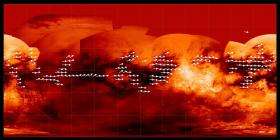
Scientists have used data from the Cassini radar mapper to map the global wind pattern on Saturn's moon Titan using data collected over a four-year period, as depicted in this image. Image: NASA/JPL/Space Science Institute

(PhysOrg.com) -- Titan's vast dune fields, which may act like weather vanes to determine general wind direction on Saturn's biggest moon, have been mapped by scientists who compiled four years of radar data collected by the Cassini spacecraft.

Titan's rippled dunes are generally oriented east-west. Surprisingly, their orientation and characteristics indicate that near the surface, Titan's winds blow toward the east instead of toward the west. This means that Titan's surface winds blow opposite the direction suggested by previous global circulation models of Titan.

"At Titan there are very few clouds, so determining which way the wind blows is not an easy thing, but by tracking the direction in which Titan's sand dunes form, we get some insight into the global wind pattern," says Ralph Lorenz, Cassini radar scientist at Johns Hopkins University Applied Physics Laboratory in Laurel, Md. "Think of the dunes sort of like a weather vane, pointing us to the direction the winds are blowing." A paper based on these findings appeared in the Feb. 11 issue of Geophysical Research Letters.

"Titan's dunes are young, dynamic features that interact with topographic obstacles and give us clues about the wind regimes," said Jani Radebaugh, Brigham Young University, Provo, Utah. "Winds come at these dunes from at least a couple of different directions, but then combine to create the overall dune orientation."

The wind pattern is important for planning future Titan explorations that might involve balloon-borne experiments.

Some 16,000 dune segments were mapped out from about 20 radar images, digitized and combined to produce the new map.

Titan's dunes are believed to be made up of hydrocarbon sand grains likely derived from organic chemicals in Titan's smoggy skies. The dunes wrap around high terrain, which provides some idea of their height. They accumulate near the equator, and may pile up there because drier conditions allow for easy transport of the particles by the wind. Titan's higher latitudes contain lakes and may be "wetter" with more liquid hydrocarbons, not ideal conditions for creating dunes.

Cassini, which launched in 1997 and is now in extended mission operations, continues to blaze its trail around the Saturn system and will visit Titan again on March 27. Seventeen Titan flybys are planned this year.

Provided by NASA

Explore further: Dark, massive asteroid to fly by Earth on May 31

add to favorites email to friend print save as pdf

Related Stories

In deserts, which dunes are the most stable?

May 28, 2010

By modeling a desert where the wind blows in two directions, French researchers from CNRS and Universite Paris Dideror have succeeded in observing and highlighting, for the very first time, the formation process ...

Titan gets a dune 'makeover'

Jan 17, 2013

(Phys.org)—Titan's siblings must be jealous. While most of Saturn's moons display their ancient faces pockmarked by thousands of craters, Titan - Saturn's largest moon - may look much younger than it really ...

Lake detected near equator of Saturn's moon Titan

Jun 13, 2012

(Phys.org) -- NASA's Cassini spacecraft has spied long-standing methane lakes, or puddles, in the "tropics" of Saturn's moon Titan. One of the tropical lakes appears to be about half the size of Utah's Great ...

New research points to erosional origin of linear dunes

Feb 24, 2012

Linear dunes, widespread on Earth and Saturn's moon, Titan, are generally considered to have been formed by deposits of windblown sand. It has been speculated for some time that some linear dunes may have ...

Putting an airplane on a distant moon

Jan 25, 2012

(PhysOrg.com) -- In addition to its rivers, oceans, mountains, sand dunes and winds, Saturn’s moon Titan may someday share another similarity with Earth: airplanes.

Cassini sees the two faces of Titan's Dunes

Jan 24, 2012

(PhysOrg.com) -- A new analysis of radar data from NASA's Cassini mission, in partnership with the European Space Agency and the Italian Space Agency, has revealed regional variations among sand dunes on Saturn's ...

Recommended for you

Dark, massive asteroid to fly by Earth on May 31

2 hours ago

It's 1.7 miles long. Its surface is covered in a sticky black substance similar to the gunk at the bottom of a barbecue. If it impacted Earth it would probably result in global extinction. Good thing it is ...

Research team explains 'Lazarus' comets

5 hours ago

Astronomers from the University of Antioquia have discovered a graveyard of comets. These once-dormant comets, dubbed by astronomers as "The Lazarus comets," are now rejuvenated.

NASA ships sensors for seafaring satellite to France

6 hours ago

(Phys.org) —Three NASA-built instruments that are integral components of the next in a series of U.S./European ocean altimetry satellites have arrived in France for integration with their spacecraft in ...

Trip into space with DiCaprio costs $1.55m

6 hours ago

Leonardo DiCaprio is going to get closer to stars of a different kind as he heads into space aboard the Virgin Galactic, and a well-heeled bidder at the Cannes Film Festival has paid 1.2 million euros (1.5 million) to be ...

User comments : 0

More news stories

Dark, massive asteroid to fly by Earth on May 31

It's 1.7 miles long. Its surface is covered in a sticky black substance similar to the gunk at the bottom of a barbecue. If it impacted Earth it would probably result in global extinction. Good thing it is ...

Source of life running out: water scientists

The majority of people on Earth people will face severe water shortages within a generation or two if pollution and waste continues unabated, scientists warned at a conference in Bonn Friday.

Facial-recognition technology proves its mettle

(Phys.org) —In a study that evaluated some of the latest in automatic facial recognition technology, researchers at Michigan State University were able to quickly identify one of the Boston Marathon bombing ...