Desert ants smell their way home
Feb 27, 2009
Cataglyphis fortis

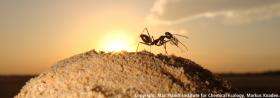
Humans lost in the desert are well known for going around in circles, prompting scientists to ask how desert creatures find their way around without landmarks for guidance. Now research published in BioMed Central's open access journal Frontiers in Zoology shows that Desert Ants input both local smells and visual cues into their navigation systems to guide them home.

Until now researchers thought that the Desert Ant Cataglyphis fortis, which makes its home in the inhospitable salt pans of Tunisia, was a pure vision-guided insect. But Kathrin Steck, Bill Hansson and Markus Knaden from the Max Planck Institute for Chemical Ecology in Jena, Germany used gas chromatography to verify that desert microhabitats do have unique odour signatures that can guide the ants back to the nest.

After having identified some odours of these signatures the researchers trained ants in field experiments to recognise these odours pointing to a hidden nest entrance. Ants learned to associate their nest entrance with a single odour and discriminated the training odour against non-training odours. They even picked out the training odour from a four-odour blend. The ants were less focused when faced with a blend rather than the pure scent of home, but still performed better in their search than those tested with the solvent control.

The use of environmentally derived olfactory landmarks has been shown for pigeons, while most ants rely rather on self generated pheromone trails. However Cataglyphis roams for over 100 meters in search for food in a habitat where high temperatures and changeable food locations make pheromone trails ineffective. This might be the reason, why these ants better go for stable olfactory landmarks that they learn at the nest entrance.

"We are amazed to discover that while keeping track of the path integrator and learning visual landmarks, these ants can also collect information about the olfactory world," said Knaden, who hopes to investigate the interaction between visual and olfactory information in future research.

More information: Smells like home: Desert ants, Cataglyphis fortis, use olfactory landmarks to pinpoint the nest
Kathrin Steck, Bill S Hansson and Markus Knaden, Frontiers in Zoology (in press), www.frontiersinzoology.com/

Source: BioMed Central

Explore further: Lonely bees make better guests

add to favorites email to friend print save as pdf

Related Stories

Snowden's life surrounded by spycraft

8 hours ago

In the suburbs edged by woods midway between Baltimore and the U.S. capital, residents long joked that the government spy shop next door was so ultra-secretive its initials stood for "No Such Agency." But ...

Winners and losers at this week's E3

8 hours ago

Since the first battles over "Pong" machines in local arcades four decades ago, video gamers have loved good competition. And this year's Electronic Entertainment Expo—the industry's largest annual gathering—presented ...

Europe's space truck docks with ISS

8 hours ago

A robot freighter bearing 6.6 tonnes of cargo docked with the International Space Station (ISS) on Saturday, the European Space Agency (ESA) said.

Secret to Prism program: Even bigger data seizure

8 hours ago

In the months and early years after the Sept. 11, 2001, terrorist attacks, FBI agents began showing up at Microsoft Corp. more frequently than before, armed with court orders demanding information on customers.

Recommended for you

Personality test finds some mouse lemurs shy, others bold

3 hours ago

Anyone who has ever owned a pet will tell you that it has a unique personality. Yet only in the last 10 years has the study of animal personality started to gain ground with behavioral ecologists, said Jennifer ...

Lonely bees make better guests

10 hours ago

Solitary bees are twice as likely to pollinate the flowers they visit as their more sociable counterparts, according to a new study.

Study reveals strategy behind spiders' web etiquette

11 hours ago

(Phys.org) —A species of spider that, unusually, lives in a colony but hunts alone at night is the subject of a new study by an international team of scientists including University of Sussex biologists.

User comments : 0

More news stories

Lonely bees make better guests

Solitary bees are twice as likely to pollinate the flowers they visit as their more sociable counterparts, according to a new study.

Study suggests new approach to fight lung cancer

Recent research has shown that cancer cells have a much different – and more complex – metabolism than normal cells. Now, scientists at The University of Texas at Dallas have found that exploiting these differences might ...