Origins of Pompeii-style artefacts examined at ISIS
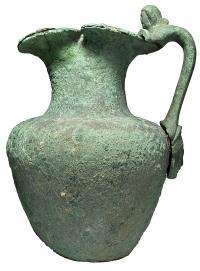
(PhysOrg.com) -- Roman artefacts which are nearly two thousand years old with similarities to ancient remains found at Pompeii in Italy will be examined at the Science and Technology Facilities Council’s ISIS neutron source this weekend. (21-22 February 2009). Researchers hope to learn more about our heritage by discovering whether the items were imported from southern Italy, or manufactured using similar techniques in Britain.
The bronze artefacts, which include a wine-mixing vessel, jugs and ceremonial pan-shaped objects, were discovered in Kent in two high status Roman pit-burials that are among the best examples ever seen in Britain. Previous excavation in an area close to the A2 where the items were found - by construction group Skanska Civil Engineering during a Highways Agency road improvement scheme - had predicted archaeological discoveries, but they were bigger than expected, with settlements ranging from the Bronze Age to the late medieval period.
Archaeological scientists will compare the 1st Century AD artefacts from Kent with those from Pompeii in Italy. The neutron beams at the world-leading ISIS facility allow for detailed crystal structure analysis of intact delicate objects without cutting out a sample of the material.
Dana Goodburn-Brown, a conservator and ancient metals specialist commissioned by Oxford Archaeology, is analysing the artefacts along with archaeological scientist Dr. Evelyne Godfrey at ISIS to see how they were made. It is hoped the experiments will answer many questions about how the items were made to give more insight into their origin: for example, the metals used in manufacturing, how they were cast and finished, and how metal pieces were joined together.
"Our experiments will hopefully aid us in characterising different Roman metalworking practices and perhaps recognising the distinction between imported south Italian goods and high standard copies produced by skilled local craftsman. These artefacts represent a time of great change in Britain - they appear shortly after the Romans arrived in this country, and may represent locals taking on cultural practices of these 'newcomers'," Dana Goodburn-Brown said.
Dr Andrew Taylor, ISIS Director said: "For these rare and highly-valued objects, analysis with neutrons can give fantastic insight. Neutrons are a very powerful way to look at matter at the molecular level and they give unique results that you can’t easily get with any other technique. The measurements are extremely delicate and non-destructive, so the objects are unharmed by the analysis and can be returned to the museums unscathed.
"The neutron beams we have at ISIS are a very versatile research tool and we’re always keen to help researchers answer a broad range of questions. Here we realised that we could take the same analysis methods we developed to look at parts of aircraft and power plants and use them to help archaeologists understand how ancient objects were traded and manufactured."
Provided by Science and Technology Facilities Council


