Web users to write ‘Hitchhiker’s Guide to the Galaxies’
(PhysOrg.com) -- Today saw the launch of Galaxy Zoo 2, a website that invites members of the public to help create a detailed guide to some of the Universe's most fascinating objects. The online project is led by a team including scientists from Oxford University.
How many arms does a spiral galaxy have? Can you spot a galaxy with a ‘peanut’ bulge? Or how about a galactic merger? Answers to these and other strange questions will be provided by ordinary web users who, by working together, have proven to be just as good at galaxy-spotting as professional astronomers.
The new initiative is a follow-up to the highly successful Galaxy Zoo project that enabled members of the public to take part in astronomy research online. But whereas the original site only asked members of the public to say whether a galaxy was spiral or elliptical, and which way it was rotating, Galaxy Zoo 2 asks them to delve deeper into 250,000 of the brightest and best galaxies to search for the strange and unusual.
The Galaxy Zoo 2 website launches today at www.galaxyzoo.org
‘The first Galaxy Zoo provided us with a Rough Guide to the sky and now we want our users to fill in all the details and create a real Hitchhiker’s Guide to the Galaxies,’ said Dr Chris Lintott of Oxford University, one of the founders of Galaxy Zoo.
Astronomers came up with the idea of getting online volunteers involved because the human brain is still better at doing pattern recognition tasks than a computer. What they had not expected was the huge enthusiasm for the project; in the last 18 months 80 million classifications of galaxies were submitted on one million objects at galaxyzoo.org by more than 150,000 armchair astronomers from all over the world.
As with the original site people are free to look at and describe as many galaxies as they like - even five minutes’ work will provide a valuable contribution. Galaxy Zoo 2 is intended to be even more fun as galaxies are pitted against each other in ‘Galaxy Wars’ (which one is more spirally?) and users can compete against their friends to describe more objects as well as record their best finds.
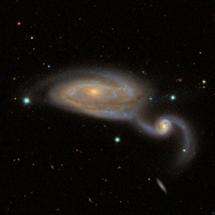
Proof that unusual discoveries can be made is the catalogue of merging galaxies provided by users - more than 3000 of these rare cosmic pile-ups have been caught in the act by Galaxy Zoo volunteers. The team have already used the IRAM radio telescope in Spain’s Sierra Nevada to follow up the most exciting mergers, and are asking for more examples to study.
The Galaxy Zoo team is led by scientists from the University of Oxford, the University of Nottingham, the University of Portsmouth, Johns Hopkins University (USA), UC Berkley (USA), Penn State (USA), Adler Planetarium, Chicago (USA), and Yale (USA), and Fingerprint Digital Media of Belfast. The development of Galaxy Zoo 2 was funded by The Leverhulme Trust, and a grant from Microsoft.
Provided by Oxford University


