New silver-based ink has applications in printed electronics
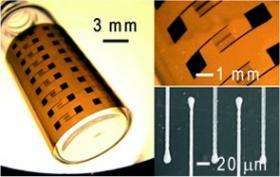
(PhysOrg.com) -- A new ink developed by researchers at the University of Illinois allows them to write their own silver linings.
The ink, composed of silver nanoparticles, can be used in electronic and optoelectronic applications to create flexible, stretchable and spanning microelectrodes that carry signals from one circuit element to another. The printed microelectrodes can withstand repeated bending and stretching with minimal change in their electrical properties.
In a paper to be published Feb. 12, by Science Express, the online version of the journal Science, Jennifer Lewis, the Thurnauer Professor of Materials Science and Engineering and director of the university's Frederick Seitz Materials Research Laboratory, and her collaborators demonstrate patterned silver microelectrodes by omnidirectional printing of concentrated nanoparticle inks with minimum widths of about 2 microns on semiconductor, plastic and glass substrates.
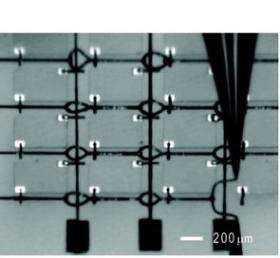
"Unlike inkjet or screen printing, our approach enables the microelectrodes to be printed out-of-plane, allowing them to directly cross pre-existing patterned features through the formation of spanning arches," Lewis said. "Typically, insulating layers or bypass electrode arrays are required in conventional layouts."
To produce printed features, the researchers first prepare a highly concentrated silver nanoparticle ink. The ink is then extruded through a tapered cylindrical nozzle attached to a three-axis micropositioning stage, which is controlled by computer-aided design software.
When printed, the silver nanoparticles are not yet bonded together. The bonding process occurs when the printed structure is heated to 150 degrees Celsius or higher. During thermal annealing, the nanoparticles fuse into an interconnected structure. Because of the modest processing temperatures required, the printed features are compatible with flexible, organic substrates.
To demonstrate the versatility of the printing process, the researchers patterned both planar and out-of-plane silver microelectrodes; produced spanning interconnects for solar microcell and light-emitting-diode arrays; and bonded silver wires to fragile, three-dimensional devices.
"Unlike conventional techniques, our approach allows fine silver wires to be bonded to delicate devices using minimal contact pressure," said postdoctoral researcher Bok Yeop Ahn, the lead author of the paper.
"Our approach is capable of creating highly integrated systems from diverse classes of electronic materials on a broad range of substrates," said graduate student Eric Duoss, a co-author of the paper. "Omnidirectional printing overcomes some of the design constraints that have limited the potential of printed electronics.
Source: University of Illinois at Urbana-Champaign


