Strength through diversity
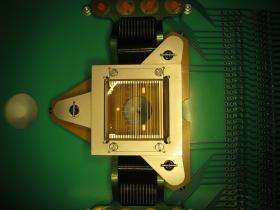
(PhysOrg.com) -- Tiny light-emitting diodes with optical microsystems that can produce all the colors of the rainbow, a new method for producing printed circuit boards - Fraunhofer researchers are showing innovative developments at the nano tech 2009 exhibition in Japan.
Good ideas are not hard to find. But only those ideas that can be implemented into new, unprecedented applications become innovations. Those wanting to develop innovative products must therefore be able to think outside the box of their own area of expertise. "Fraunhofer's strength lies in interaction. When the Institutes pool their competencies, the result is enormous potential for innovation," as Dr. Michael Popall from the Fraunhofer Institute for Silicate Research ISC in Würzburg, Germany knows. The team is developing new nanotech products in cooperation with researchers at various Fraunhofer Institutes. Some of these products can be seen from 18 to 20 February 2009 at this year's nano tech in Tokyo.
Highly-efficient light-emitting diodes, LEDs for short, are incredibly tiny and yet also enormously versatile: they can be put to use to light buildings, vehicles and traffic signs. They can even be used for projecting images. Researchers from the Fraunhofer Institute for Applied Optics and Precision Engineering IOF have developed a special optical microsystem for this purpose. This system consists of a primary optical system that aligns the light and a secondary one that spreads the waves uniformly. Micro-lens arrays handle the second part. These arrays are made of float glass that has been coated on both sides with ORMOCER®, an inorganic-organic hybrid polymer developed by ISC. The micro-lens structure is imprinted into these polymer layers and cured with UV light. This is done on both sides in one mirror-symmetric process step. ORMOCER® microstructures not only have very high photon permeability, they also withstand constant high temperatures and light intensities, and so result in an optical system that is powerful and durable.
Fraunhofer researchers are also pursuing interdisciplinary developments in new technologies for manufacturing printed circuit boards. The experts at the Fraunhofer Institute for Manufacturing Technology and Applied Materials Research IFAM are adapting rapid prototyping printing technology to the requirements of board and module manufacturers. The nanomaterials for PCB tracks and for insulating intermediate layers can consequently be applied to a substrate layer by layer. The ISC team developed a new ORMOCER® for this and furthermore contributed know-how in handling the nanometer-sized hybrid polymers. The experts from the Fraunhofer Institute for Integrated Circuits IIS took over the design of test chips, while their colleagues from the Fraunhofer Institute for Reliability and Microintegration IZM handled the testing and design of the board itself. The new method is ideal for manufacturing prototypes and small series of complex printed circuit boards with high integration levels. Popall explains, "Although the manufacturing takes longer than when classic lithographic methods are used, and it is also not cheap, it is possible to eliminate the very expensive manufacture of masks and to gain design flexibility.”
Carbon nanotubes, or CNT for short, are opening up more and more new possibilities for the researchers. The experts from the Fraunhofer Institute for Manufacturing Engineering and Automation IPA are presenting a composite material at the exhibition. This material can be used to manufacture seat heaters, floor heating, boilers, bathroom mirrors that do not fog up and even handlebar heaters. The nanotubes, which very efficiently convert electricity into heat, are integrated into the parts as a filling material. They give the finished product the required mechanical, electrical and thermal properties.
"Fraunhofer’s strength lies in the enormous spectrum of diverse competencies," Popall continues. "When we pool these, we have almost unsurpassable potential for developing new things, and not only in nanotechnology."
Provided by Fraunhofer-Gesellschaft


