Origin of claws seen in 390-million-year-old fossil
Feb 05, 2009
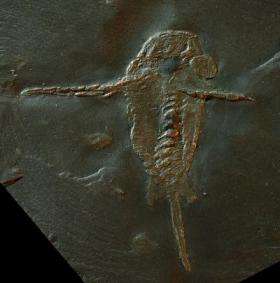
This is a photograph of Schinderhannes bartelsi. Credit: Steinmann Institute/University of Bonn

A missing link in the evolution of the front claw of living scorpions and horseshoe crabs was identified with the discovery of a 390 million-year-old fossil by researchers at Yale and the University of Bonn, Germany.

The specimen, named Schinderhannes bartelsi, was found fossilized in slate from a quarry near Bundenbach in Germany, a site that yields spectacularly durable pyrite-preserved fossils — findings collectively known as the Hunsrück Slate. The Hunsrück Slate has previously produced some of the most valuable clues to understanding the evolution of arthropods - including early shrimp-like forms, a scorpion and sea spiders as well as the ancient arthropods trilobites.

"With a head like the giant Cambrian aquatic predator Anomalocaris and a body like a modern arthropod, the specimen is the only known example of this unusual creature," said Derek Briggs, director of Yale's Peabody Museum of Natural History and an author of the paper appearing in the journal Science.
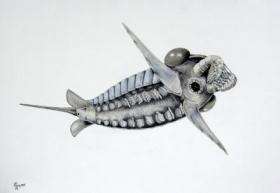
Reconstruction of Schinderhannes bartelsi. Credit: Elke Groening

Scientists have puzzled over the origins of the paired grasping appendages found on the heads of scorpions and horseshoe crabs. The researchers suggest that Schinderhannes gives a hint. Their appendages may be an equivalent to those found in the ancient predatory ancestor, Anomalocaris — even though creatures with those head structures were thought to have become extinct by the middle of the Cambrian Period, 100 million years before Schinderhannes lived.


Join PhysOrg.com on Facebook

The fossil's head section has large bulbous eyes, a circular mouth opening and a pair of segmented, opposable appendages with spines projecting inward along their length. The trunk section is made up of 12 segments, each with small appendages, and a long tail spine. Between the head and trunk, there is a pair of large triangular wing-like limbs — that likely propelled the creature like a swimming penguin, according to Briggs. Unlike its ancestors from the Cambrian period, which reached three feet in length, Schinderhannes is only about 4 inches long.

This finding caps almost 20 years of study by Briggs on the Hunsrück Slate. "Sadly, the quarry from which this fabulous material comes has closed for economic reasons, so the only additional specimens that are going to appear now are items that are already in collectors' hands and that may not have been fully prepared or realized for what they are," said Briggs.

Source: Yale University

Explore further: Actor Johnny Depp immortalized in ancient fossil find

add to favorites email to friend print save as pdf

Related Stories

LinkedIn looks to build on its impressive resume

3 hours ago

LinkedIn and Facebook will celebrate the anniversaries of their IPOs just a few days apart this week. But their experiences as publicly traded companies couldn't be more different.

Recommended for you

The eloquence of the otoliths

May 16, 2013

Fish fossils that are about 23 million years old give unprecedented insight into the evolutionary history of the gobioid order, one of the most species-rich groups among the modern bony fishes.

Light cast on lifestyle and diet of first New Zealanders

May 16, 2013

(Phys.org) —A University of Otago-led multidisciplinary team of scientists have shed new light on the diet, lifestyles and movements of the first New Zealanders by analysing isotopes from their bones and teeth.

mtDNA study shows Minoans came from Europe not Africa

May 15, 2013

(Phys.org) —A new study conducted by a team of American and Greek researchers has found that the people of the ancient Minoan civilization living on the island of Crete most likely came from Europe. In ...

User comments : 2

Adjust slider to filter visible comments by rank

Display comments: newest first

Mercury_01
5 / 5 (1) Feb 05, 2009
Do the shrimp have large talons?
LuckyBrandon
not rated yet Feb 05, 2009
i dont see why they just dont fence it up with razor wire (the whole slate). economic woes my ass..it doesnt cost anything for a piece of land to just "be" there.
its quite possible its ancestor did die off 100 million years earlier...we just need to find the direct predecessor is all. it will turn up eventually, just like it all does.

More news stories

Evolution of lying

(Phys.org) —Ultimately, our ability to convincingly lie to each other may have evolved as a direct result of our cooperative nature.

Galaxy's Ring of Fire

Johnny Cash may have preferred this galaxy's burning ring of fire to the one he sang about falling into in his popular song. The "starburst ring" seen at center in red and yellow hues is not the product of ...

US seizes Bitcoin operator accounts

US authorities seized the accounts of a Bitcoin digital currency exchange operator, claiming it was functioning as an "unlicensed money service business," court documents showed Friday.