Physicists observe kink in the dispersion of f-electrons
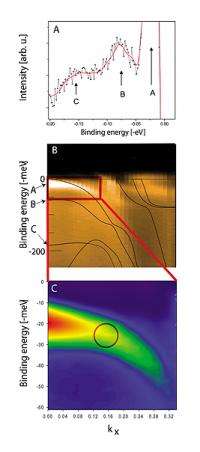
(PhysOrg.com) -- Los Alamos researchers in collaboration with colleagues in US and Europe report on the observation of a kink in the dispersion of f-electrons in USb2.
In a letter published in Europhysics Letters the researchers describe their discovery of a small energy scale in f-electron material, USb2, where for the first time a kink in f-electron dispersion is observed. Kink energy scale of 21meV and the ultra-small intrinsic peak width of 3 meV are seen. Strong interactions in correlated electron systems may result in the formation of heavy quasi-particles that exhibit kinks in their dispersion relation. However, kinks in band dispersions have so far been observed in d-electron systems. Current finding extends the context of quasiparticle band renormalization from d-electrons to f-electrons, hence creating a link between high temperature superconductors and heavy fermions and actinides.
A new model of point-like Fermi surface renormalization is proposed to explain the spectroscopic properties of the kink. Spectral weight is incoherently shifted away from the Fermi energy, but Luttinger's theorem requires the Fermi volume to remain constant. Even though the renormalized quasiparticle band in USb2 starts at 17 meV below the Fermi energy, the spectrum associated with this band still shows properties of a renormalized Fermi liquid, such as the kink in the dispersion relation and ultra-sharp quasiparticle peaks. These features may be assigned to interband electron-boson scattering processes, with asymmetry being controlled by intraband scattering.
High resolution photoelectron spectroscopy methods of analyzing the spectral function allowed better understanding of high temperature superconductivity. Such approach still has to play its role in f-electron systems, hopefully leading to breakthroughs similar to those observed in unconventional superconductors within the last decade.
The work was performed under the auspices of the U.S. DOE and LANL LDRD Program. All measurements were done at the Synchrotron Radiation Center (SRC).
Paper: Observation of a kink in the dispersion of f-electrons, T. Durakiewicz, P.S. Riseborough, C.G. Olson, J.J. Joyce, E. Bauer, J.L. Sarrao, S. Elgazzar, P.M. Oppeneer, E. Guziewicz, D.P. Moore, M.T. Butterfield, K.S. Graham, (2008) Europhys. Lett. 84 (2008) 37003. www.iop.org/EJ/article/-search … /epl_84_3_37003.html
Provided by University of Wisconsin-Madison


