NASA Radar Provides First Look Inside Moon's Shadowed Craters
Jan 16, 2009
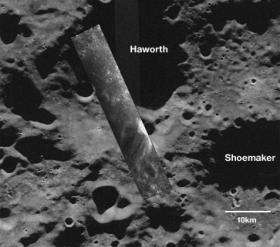
This image is a Mini-RF synthetic aperture radar (SAR) strip overlain on an Earth-based, Arecibo Observatory radar telescope image. Taken Nov. 17, 2008, the south-polar SAR strip shows a part of the moon never seen before: a portion of Haworth crater that is permanently shadowed from Earth and the sun. The only way to explore these regions is by using an orbital radar such as Mini-RF. Credit: ISRO/NASA/JHUAPL/LPI/Cornell University/Smithsonian

(PhysOrg.com) -- Using a NASA radar flying aboard India's Chandrayaan-1 spacecraft, scientists are getting their first look inside the moon's coldest, darkest craters.

The Mini-SAR instrument, a lightweight, synthetic aperture radar, has passed its initial in-flight tests and sent back its first data. The images show the floors of permanently-shadowed polar craters on the moon that aren't visible from Earth. Scientists are using the instrument to map and search the insides of the craters for water ice.

"The only way to explore such areas is to use an orbital imaging radar such as Mini-SAR," said Benjamin Bussey, deputy principal investigator for Mini-SAR, from the Johns Hopkins University Applied Physics Laboratory in Laurel, Md. "This is an exciting first step for the team which has worked diligently for more than three years to get to this point."

The images, taken on Nov. 17, 2008, cover part of the Haworth crater at the moon's south pole and the western rim of Seares crater, an impact feature near the north pole. Bright areas in each image represent either surface roughness or slopes pointing toward the spacecraft. Further data collection by Mini-SAR and analysis will help scientists to determine if buried ice deposits exist in the permanently shadowed craters near the moon's poles.

"During the next few months we expect to have a fully calibrated and operational instrument collecting valuable science data at the moon," said Jason Crusan, program executive for the Mini-RF Program for NASA's Space Operations Mission Directorate in Washington.

Mini-SAR is one of 11 instruments on the Indian Space Research Organization's Chandrayaan-1 and one of two NASA-sponsored contributions to its international payload. The other is the Moon Mineralogy Mapper, a state-of-the-art imaging spectrometer that will provide the first map of the entire lunar surface at high spatial and spectral resolution. Data from the two NASA instruments will contribute to the agency's increased understanding of the lunar environment as it implements America's space exploration plan, which calls for robotic and human missions to the moon.

Chandrayaan-1 launched from India's Satish Dhawan Space Center on Oct. 21 and began orbiting the moon Nov. 8. The Applied Physics Laboratory performed the final integration and testing on Mini-SAR. It was developed and built by the Naval Air Warfare Center and several other commercial and government contributors. The Applied Physics Laboratory's Satellite Communications Facility is Chandrayaan-1's primary ground station in the Western Hemisphere.

These first images and other information about NASA's Mini-SAR, also known as Mini-RF, can be found at: www.nasa.gov/mini-rf

For more information about the Moon Mineralogy Mapper, visit: m3.jpl.nasa.gov

For more information about Chandrayaan-1, visit: www.isro.org/Chandrayaan

Provided by NASA

Explore further: Collisions of coronal mass ejections can be super-elastic

add to favorites email to friend print save as pdf

Related Stories

Asteroid's troughs suggest stunted planet

Sep 26, 2012

(Phys.org)—Enormous troughs that reach across the asteroid Vesta may actually be stretch marks that hint of a complexity beyond most asteroids. Scientists have been trying to determine the origin of these ...

Working models for the gravitational field of Phobos

Mar 05, 2012

Phobos is the larger and closer of the two natural satellites of Mars. Despite decades of Martian exploration, we still know very little about Phobos. Many fundamental properties of this small potato-shaped body stay vague, ...

Curtin geologists make a 'shocking' discovery

Jan 24, 2012

Research led by Curtin University geologists has uncovered a wealth of new evidence in the mineral zircon from lunar rock samples recovered during NASA’s Apollo missions, revealing indisputable proof ...

Recommended for you

Forecast for Titan: Wild weather could be ahead

12 hours ago

(Phys.org) —Saturn's moon Titan might be in for some wild weather as it heads into its spring and summer, if two new models are correct. Scientists think that as the seasons change in Titan's northern hemisphere, ...

SDO observes mid-level solar flare

12 hours ago

UPDATE 16:30 p.m. EDT: The M7-class flare was also associated with a coronal mass ejection or CME, another solar phenomenon that can send billions of tons of particles into space. While this CME was not Ea ...

NASA's IRIS mission readies for a new challenge

21 hours ago

(Phys.org) —The time draws near. NASA is getting ready to launch a new mission, a mission to observe a largely unexplored region of the solar atmosphere that powers its dynamic million-degree outer atmosphere and drives ...

User comments : 2

Adjust slider to filter visible comments by rank

Display comments: newest first

morpheus2012
1 / 5 (1) Jan 19, 2009
morpheus2012
1 / 5 (1) Jan 20, 2009

More news stories

Forecast for Titan: Wild weather could be ahead

(Phys.org) —Saturn's moon Titan might be in for some wild weather as it heads into its spring and summer, if two new models are correct. Scientists think that as the seasons change in Titan's northern hemisphere, ...

Scientists announce Top 10 New Species from 2012

An amazing glow-in-the-dark cockroach, a harp-shaped carnivorous sponge and the smallest vertebrate on Earth are just three of the newly discovered top 10 species selected by the International Institute for ...

Theorists weigh in on where to hunt dark matter

(Phys.org) —Now that it looks like the hunt for the Higgs boson is over, particles of dark matter are at the top of the physics "Most Wanted" list. Dozens of experiments have been searching for them, but ...