Exoplanet atmospheres detected from Earth for the first time
Jan 14, 2009
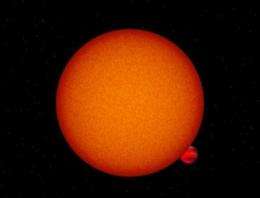
This is an artist's impression of the star OGLE-TR-56 and its planet, as the planet is passing behind the star. Credit: D. Sing (IAP) / A&A

(PhysOrg.com) -- Transiting exoplanets are routinely detected when they pass in front of their parent star as viewed from the Earth, which only happens by chance. The transit event causes a small drop in the observed starlight, which can then be detected. Fifty-five exoplanets have been detected this way since the observation of the first transiting planet HD 209458 b in 1999.

When the planet revolves around its star or when it goes behind, the light coming from the system also varies, though the resulting smaller modulation is much harder to detect. This is mostly due to the small amount of light emitted by these exoplanets which are believed to be as dark as coal and reflect little of the incoming starlight. Fortunately, some of these planets are very hot, thus emitting light, mostly at infrared wavelengths. Up to now, detections of this kind have only been made using the Spitzer infrared space telescope.

This week, Astronomy & Astrophysics is publishing the two first ground-based detections of thermal emission from transiting, hot-Jupiter exoplanets, from two independent teams of astronomers that used different approaches.

One team includes Ernst De Mooij and Ignas Snellen (University of Leiden, Netherlands) who used the William Hershel 4.2 meter telescope in La Palma (Canary Islands, Spain) to observe the star TrES-3 and its planet TrES-3b. To be able to detect the light coming from the planet, they observed the planet exactly at the time when it passes behind the star.

They observed the event at infrared wavelengths, where the planet is at its brightest compared to the star (even if the planet is still much fainter than the star!) As they detected the light coming from the planet, they estimated the temperature of its atmosphere to about 2000 Kelvins. This indicates that the day side of the planet is extremely hot.

The other team, involving David Sing (IAP, France) and Mercedes Lopez-Morales (Carnegie Institution of Washington, USA), had a different approach. They looked at a much fainter star and its planet, OGLE-TR-56b. This planet is one of the most irradiated planets known so far, both because the planet is very close to the star and because the star is very hot. To detect the slight modulation in light that occurs when the planet passes behind its star, they used the 8 meter Very Large Telescope (ESO, Chile) and the 6.5 meter Magellan Telescopes (Las Campanas, Chile) and were able to observe this event at visible wavelengths.

Indeed, the planet OGLE-TR-56b is heated so much by its star that it emits detectable amounts of light in the visible wavelengths, and not only in the infrared as TrES-3b does. Hence, Sing and Lopez-Morales measured the record-high temperature of a planetary atmosphere: 2700 Kelvins. As in the case of TrES-3b, such a high day-side temperature indicates that winds cannot redistribute the heat efficiently from the day side to the night side.

These two independent results are very interesting for astronomers and planetary scientists because they allow a direct probe of the temperature of these planetary atmospheres, and because they show that such measurements can be made from ground-based observatories, and not only when using space telescopes.

Provided by Astronomy & Astrophysics

Explore further: Galaxy's Ring of Fire

add to favorites email to friend print save as pdf

Related Stories

Hubble finds dead stars 'polluted' with planetary debris

May 09, 2013

(Phys.org) —The NASA/ESA Hubble Space Telescope has found signs of Earth-like planets in an unlikely place: the atmospheres of a pair of burnt-out stars in a nearby star cluster. The white dwarf stars are ...

Sifting through the atmospheres of far-off worlds

May 09, 2013

(Phys.org) —Gone are the days of being able to count the number of known planets on your fingers. Today, there are more than 800 confirmed exoplanets—planets that orbit stars beyond our sun—and more ...

Landing is key puzzle in Mars trip, experts say

May 08, 2013

Landing astronauts safely on Mars is one of the biggest technological hurdles for any future manned mission to the Red Planet, even more complicated than last year's daring rover touchdown.

Recommended for you

Galaxy's Ring of Fire

May 18, 2013

Johnny Cash may have preferred this galaxy's burning ring of fire to the one he sang about falling into in his popular song. The "starburst ring" seen at center in red and yellow hues is not the product of ...

4C+29.30: Black hole powered jets plow into galaxy

May 15, 2013

(Phys.org) —This composite image of a galaxy illustrates how the intense gravity of a supermassive black hole can be tapped to generate immense power. The image contains X-ray data from NASA's Chandra X-ray ...

A space-time magnifying glass

May 15, 2013

(Phys.org) —Bright arcs are smeared around the heart of galaxy cluster Abell S1077 in this image taken by the NASA/ESA Hubble space telescope. The arcs are stretched images of distant galaxies distorted ...

User comments : 4

Adjust slider to filter visible comments by rank

Display comments: newest first

el_gramador
2 / 5 (1) Jan 15, 2009
Cue "burn baby burn"
yyz
1 / 5 (1) Jan 17, 2009
Any chance that large Earth-bound observatories, HST or Spitzer may be able to unambiguously detect elements or hi-temp compounds in the atmospheres of these planets? I realize that disentangling these complex spectra will not be easy, but is it now possible to do so (however crudely), or will this have to await larger ground-based telescopes or the likes of the Webb Space Telescope?
theophys
5 / 5 (1) Jan 17, 2009
Any chance that large Earth-bound observatories, HST or Spitzer may be able to unambiguously detect elements or hi-temp compounds in the atmospheres of these planets? I realize that disentangling these complex spectra will not be easy, but is it now possible to do so (however crudely),

I don't see why not.
yyz
1 / 5 (1) Jan 17, 2009
Would large radio telescope networks (VLBI comes to mind) be of any use with objects of this type? Could a radio interferometers' extremely high resolution be of any use, if not to chemically characterize atmospheric constituents, than to provide other useful properties of these transiting exoplanets (e.g. precise orbital predictions, magnetic fields (if any), debris disks, planet and atmospheric densities and more precise temperatures, etc)?

More news stories

Heat-related deaths in Manhattan projected to rise

Residents of Manhattan will not just sweat harder from rising temperatures in the future, says a new study; many may die. Researchers say deaths linked to warming climate may rise some 20 percent by the 2020s, ...

Mice, gerbils perish in Russia space flight

A number of mice and eight gerbils sent into space in a Russian capsule destined to find out how well organisms can withstand extended flights perished during their journey, scientists said Sunday as the ...

ER docs are key to reducing health care costs

Emergency physicians are key decisionmakers for nearly half of all hospital admissions, highlighting a critical role they can play in reducing health care costs, according to a new report from the RAND Corporation.