Discovery Nears February Launch to Station
Jan 13, 2009
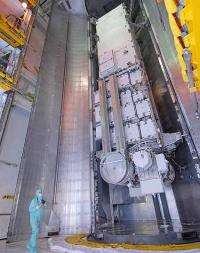
At Kennedy's Launch Pad 39A the open doors of the payload canister reveal the S6 integrated truss structure and U.S. solar arrays for the STS-119 mission. Photo credit: NASA/Chris Rhodes

(PhysOrg.com) -- Space shuttle Discovery's installation to its external fuel tank and solid rocket boosters was completed Sunday afternoon.

The shuttle stack atop the mobile launcher platform is scheduled to roll out to Kennedy Space Center's Launch Pad 39A at 4 a.m. EST Jan. 14.

The 3.4-mile journey from the Vehicle Assembly Building to the launch pad aboard NASA's crawler-transporter will take about six hours.

Discovery's cargo, the S6 truss segment and solar arrays, was transferred to the pad Sunday and is being lifted into the pad's changeout room today. The equipment will remain there until the shuttle arrives and it's loaded into the payload bay.

At NASA's Johnson Space Center in Houston, the STS-119 astronauts are rehearsing in the fixed base simulator. The crew spends many hours training with dials and controls identical to that of the shuttle computer and screens that animate the view from outside the shuttle's window. Johnson technicians program the simulator's software to throw various problem situations at the crew to make sure they can cope with anything while in flight.

Provided by NASA

Explore further: Communications satellite launched into space

add to favorites email to friend print save as pdf

Related Stories

Entrepreneur giving shuttle truss new uses

May 15, 2013

(Phys.org) —A truss design devised to help workers process space shuttles continues to find new uses as a space shuttle engineer-turned-entrepreneur adapts it to everything from a solar-powered electric ...

Recommended for you

Dark, massive asteroid to fly by Earth on May 31

May 24, 2013

It's 1.7 miles long. Its surface is covered in a sticky black substance similar to the gunk at the bottom of a barbecue. If it impacted Earth it would probably result in global extinction. Good thing it is ...

Research team explains 'Lazarus' comets

May 24, 2013

Astronomers from the University of Antioquia have discovered a graveyard of comets. These once-dormant comets, dubbed by astronomers as "The Lazarus comets," are now rejuvenated.

NASA ships sensors for seafaring satellite to France

May 24, 2013

(Phys.org) —Three NASA-built instruments that are integral components of the next in a series of U.S./European ocean altimetry satellites have arrived in France for integration with their spacecraft in ...

Trip into space with DiCaprio costs $1.55m

May 24, 2013

Leonardo DiCaprio is going to get closer to stars of a different kind as he heads into space aboard the Virgin Galactic, and a well-heeled bidder at the Cannes Film Festival has paid 1.2 million euros (1.5 million) to be ...

User comments : 0

More news stories

Galaxies fed by funnels of fuel

(Phys.org) —Computer simulations of galaxies growing over billions of years have revealed a likely scenario for how they feed: a cosmic version of swirly straws.

Century-old science helps confirm global warming

(Phys.org) —Ocean measurements taken more than 135 years ago during the scientific expedition of HMS Challenger have provided further confirmation of human-produced global warming over the past century.