XMM-Newton measures speedy spin of rare celestial object
Jan 13, 2009
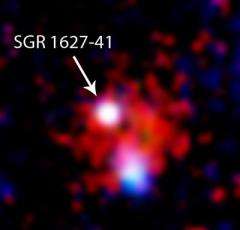
False colour X-ray image of the sky region around SGR 1627-41 obtained with XMM-Newton. The emission indicated in red comes from the debris of an exploded massive star. It covers a region more extended than that previously deduced from radio observations, surrounding the SGR. This suggests that the exploded star was the magnetar’s progenitor. Credits: ESA/XMM-Newton/EPIC (P. Esposito et al.)

(PhysOrg.com) -- XMM-Newton has caught the fading glow of a tiny celestial object, revealing its rotation rate for the first time. The new information confirms this particular object as one of an extremely rare class of stellar zombie - each one the dead heart of a star that refuses to die.

There are just five so-called Soft Gamma-ray Repeaters (SGRs) known, four in the Milky Way and one in our satellite galaxy, the Large Magellanic Cloud. Each is between 10 and 30 km across, yet contains about twice the mass of the Sun. Each one is the collapsed core of a large star that has exploded, collectively called neutron stars.

What sets the Soft Gamma-ray Repeaters apart from other neutron stars is that they possess magnetic fields that are up to 1000 times stronger. This has led astronomers to call them magnetars.

SGR 1627-41 was discovered in 1998 by NASA's Compton Gamma Ray Observatory when it burst into life emitting around a hundred short flares during a six-week period. It then faded before X-ray telescopes could measure its rotation rate. Thus, SGR 1627-41 was the only magnetar with an unknown period.

Last summer, SGR 1627-41 flared back into life. But it was located in a region of sky that ESA's XMM-Newton was unable to point at for another four months. This was because XMM-Newton has to keep its solar panels turned towards the Sun for power. So astronomers waited until Earth moved along its orbit, carrying XMM-Newton with it and bringing the object into view. During that time, SGR 1627-41 began fading fast. When it came into view in September 2008, thanks to the superior sensitivity of the EPIC instrument on XMM-Newton, it was still detectable.

A team of astronomers took the necessary observations and revealed that it rotates once every 2.6 seconds. "This makes it the second fastest rotating magnetar known," says Sandro Mereghetti, INAF/Istituto di Astrofisica Spaziale e Fisica Cosmica, Milan, one of the team.

Theorists are still puzzling over how these objects can have such strong magnetic fields. One idea is that they are born spinning very quickly, at 2-3 milliseconds. Ordinary neutron stars are born spinning at least ten times more slowly. The rapid rotation of a new-born magnetar, combined with convection patterns in its interior, gives it a highly efficient dynamo, which builds up such an enormous field.

With a rotation rate of 2.6 seconds, this magnetar must be old enough to have slowed down. Another clue to the magnetar's age is that it is still surrounded by a supernova remnant. During the measurement of its rotation rate, XMM-Newton also detected X-rays coming from the debris of an exploded star, possibly the same one that created the magnetar. "These usually fade to invisibility after a few tens of thousand years. The fact that we still see this one means it is probably only a few thousand years old", says Mereghetti.

If it flares again, the team plan to re-measure its rotation rate. Any difference will tell them how quickly the object is decelerating. There is also the chance that SGR 1627-41 will release a giant flare. Only three such events have been seen in the last 30 years, each from a different SGR, but not from SGR 1627-41.

These superflares can supply as much energy to Earth as solar flares, even though they are halfway across the Galaxy, whereas the Sun is at our celestial doorstep. "These are intriguing objects; we have much still to learn about them," says Mereghetti.

Provided by European Space Agency

Explore further: Detection of the cosmic gamma ray horizon: Measures all the light in the universe since the Big Bang

add to favorites email to friend print save as pdf

Related Stories

Pulsar jackpot scours old data for new discoveries

Feb 28, 2013

Chalk another one up for Citizen Science.  Earlier this month, researchers announced the discovery of 24 new pulsars. To date, thousands of pulsars have been discovered, but what's truly fascinating abou ...

Star's 'cry' heralds new era for testing relativity

Aug 02, 2012

(Phys.org) -- Last year, astronomers discovered a quiescent black hole in a distant galaxy that erupted after shredding and consuming a passing star. Now researchers have identified a distinctive X-ray signal ...

Recommended for you

Galaxies fed by funnels of fuel

16 hours ago

(Phys.org) —Computer simulations of galaxies growing over billions of years have revealed a likely scenario for how they feed: a cosmic version of swirly straws.

Hubble reveals the ring nebula's true shape

May 23, 2013

(Phys.org) —The Ring Nebula's distinctive shape makes it a popular illustration for astronomy books. But new observations by NASA's Hubble Space Telescope of the glowing gas shroud around an old, dying, ...

User comments : 1

Adjust slider to filter visible comments by rank

Display comments: newest first

yyz
1 / 5 (1) Jan 17, 2009
Initially, I thought this object to have a Type Ia progenitor, a probable recurrent novae consisting of a white dwarf drawing matter off its' red giant companion & in the process spinning up the resultant neutron star & winding up its magnetic field as seen in magnetars. A reply to my comment (posted at Universe Today by GBendt( see this story & comments posted at Universe Today 1-13-09) lays out the case that this object was probably a Type II event( subtype non-specified) which implies a 'core-collapse' event by a single star. No mention was made in the ESA press release as to the progenitors' type (Note that a Type II event can also spin-up a neuron star-magnetar)(Thanks GBendt). But nowhere can I pin down exactly what type of SN event produced this SGR-magnetar. Colliding WD-NS and NS-NS scenarios also can't be ruled out. So my question is what was the leading theory for the progenitor(s) of this enigmatic object?

More news stories

Galaxies fed by funnels of fuel

(Phys.org) —Computer simulations of galaxies growing over billions of years have revealed a likely scenario for how they feed: a cosmic version of swirly straws.

Source of life running out: water scientists

The majority of people on Earth people will face severe water shortages within a generation or two if pollution and waste continues unabated, scientists warned at a conference in Bonn Friday.

Dark, massive asteroid to fly by Earth on May 31

It's 1.7 miles long. Its surface is covered in a sticky black substance similar to the gunk at the bottom of a barbecue. If it impacted Earth it would probably result in global extinction. Good thing it is ...

Yahoo, pay-TV operators among Hulu bidders

Online video site Hulu is again up for sale, with Yahoo and pay TV operators DirecTV and Time Warner Cable among the seven bidders, according to a person with direct knowledge of the matter.

Radiation leak at Japan lab; small impact expected

An atomic research lab in northern Japan has reported a radiation leak that may have affected about 50 people, though none were hospitalized and no impact was expected outside the facility, the lab's operator ...