Biggest Full Moon of the Year: Take 2
Jan 08, 2009
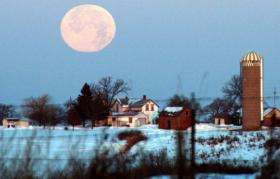
The perigee full of Dec. 2008. "A cold wind was blowing as the Moon set over a neighbor's farm," says photographer Eric Ingmundson of Sparta, Wisconsin. "Next time (Jan. 10th) I plan to use a tripod."

When last month's full Moon rose over Florida, onlooker Raquel Stanton of Cocoa Beach realized that something was up.

"The Moon was stunningly gorgeous--and it looked bigger than usual!" she says. "My whole family noticed and watched in awe."

Like millions of others around the world, she had witnessed the biggest full Moon of 2008--a "perigee Moon," 14% wider and 30% brighter than lesser Moons she had seen before. "I'll never forget it."

Alert: It's about to happen again.

This Saturday night, Jan. 10th, another perigee Moon is coming. It's the biggest full Moon of 2009, almost identical to the one that impressed onlookers in Dec. 2008.

Johannes Kepler explained the phenomenon 400 years ago. The Moon's orbit around Earth is not a circle; it is an ellipse, with one side 50,000 km closer to Earth than the other. Astronomers call the point of closest approach "perigee," and that is where the Moon will be this weekend.

Perigee full Moons come along once or twice a year. 2008 ended with one and now 2009 is beginning with another. It's the best kind of déjà vu for people who love the magic of a moonlit landscape.

January is a snowy month in the northern hemisphere, and the combination of snow + perigee moonlight is simply amazing. When the Moon soars overhead at midnight, the white terrain springs to life with a reflected glow that banishes night, yet is not the same as day. You can read a newspaper, ride a bike, write a letter, and at the same time count the stars overhead. It is an otherworldly experience that really must be sampled first hand.

Another magic moment happens when the perigee Moon is near the horizon. That is when illusion mixes with reality to produce a truly stunning view. For reasons not fully understood by astronomers or psychologists, low-hanging Moons look unnaturally large when they beam through trees, buildings and other foreground objects. This weekend, why not let the "Moon illusion" amplify a full Moon that's extra-big to begin with? The swollen orb rising in the east at sunset may seem so nearby, you catch yourself reaching out to touch it.

You won't be the only one. Even at perigee, the Moon is 360,000 km away, yet the distant beauty beckons to poets, stargazers and NASA with equal force: "Come back," it seems to say, "I'm really not so far away."

Source: by Dr. Tony Phillips, Science@NASA

Explore further: Mice, gerbils perish in Russia space flight

add to favorites email to friend print save as pdf

Related Stories

Image: Super Perigee Moon

Mar 21, 2011

(PhysOrg.com) -- The full moon is seen as it rises near the Lincoln Memorial, Saturday, March 19, 2011, in Washington.

Super full moon

Mar 17, 2011

Mark your calendar. On March 19th, a full Moon of rare size and beauty will rise in the east at sunset. It's a super "perigee moon"--the biggest in almost 20 years.

Biggest Full Moon of the Year

Dec 10, 2008

No, you can not see Neil Armstrong's footprint. But go ahead and look: The full Moon of Dec. 12th is the biggest and brightest full Moon of the year.

Recommended for you

Mice, gerbils perish in Russia space flight

13 hours ago

A number of mice and eight gerbils sent into space in a Russian capsule destined to find out how well organisms can withstand extended flights perished during their journey, scientists said Sunday as the ...

Mars rover Opportunity examines clay clues in rock

May 18, 2013

(Phys.org) —NASA's senior Mars rover, Opportunity, is driving to a new study area after a dramatic finish to 20 months on "Cape York" with examination of a rock intensely altered by water.

NASA's STEREO detects a CME from the sun

May 17, 2013

On 5:24 a.m. EDT on May 17, 2013, the sun erupted with an Earth-directed coronal mass ejection or CME, a solar phenomenon that can send billions of tons of solar particles into space that can reach Earth ...

Nine-year-old Mars rover passes 40-year-old record

May 17, 2013

While Apollo 17 astronauts Eugene Cernan and Harrison Schmitt visited Earth's moon for three days in December 1972, they drove their mission's Lunar Roving Vehicle 19.3 nautical miles (22.210 statute miles ...

Bright explosion on the Moon

May 17, 2013

For the past 8 years, NASA astronomers have been monitoring the Moon for signs of explosions caused by meteoroids hitting the lunar surface. "Lunar meteor showers" have turned out to be more common than anyone ...

User comments : 0

More news stories

Heat-related deaths in Manhattan projected to rise

Residents of Manhattan will not just sweat harder from rising temperatures in the future, says a new study; many may die. Researchers say deaths linked to warming climate may rise some 20 percent by the 2020s, ...

Mice, gerbils perish in Russia space flight

A number of mice and eight gerbils sent into space in a Russian capsule destined to find out how well organisms can withstand extended flights perished during their journey, scientists said Sunday as the ...

Kinks and curves at the nanoscale

One of the basic principles of nanotechnology is that when you make things extremely small—one nanometer is about five atoms wide, 100,000 times smaller than the diameter of a human hair—they are going ...

Honeybees trained in Croatia to find land mines

(AP)—Mirjana Filipovic is still haunted by the land mine blast that killed her boyfriend and blew off her left leg while on a fishing trip nearly a decade ago. It happened in a field that was supposedly ...