Baby Jupiters must gain weight fast
Jan 05, 2009
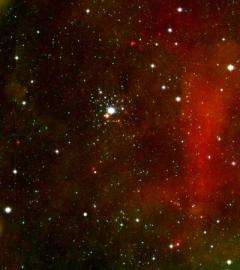
This photograph from NASA's Spitzer Space Telescope shows the young star cluster NGC 2362. By studying it, astronomers found that gas giant planet formation happens very rapidly and efficiently, within less than 5 million years, meaning that Jupiter-like worlds experience a growth spurt in their infancy. Image: NASA/JPL-Caltech/T. Currie (CfA)

The planet Jupiter gained weight in a hurry during its infancy. It had to, since the material from which it formed probably disappeared in just a few million years, according to a new study of planet formation around young stars.

Smithsonian astronomers examined the 5 million-year-old star cluster NGC 2362 with NASA's Spitzer Space Telescope, which can detect the signatures of actively forming planets in infrared light. They found that all stars with the mass of the Sun or greater have lost their protoplanetary (planet-forming) disks. Only a few stars less massive than the Sun retain their protoplanetary disks. These disks provide the raw material for forming gas giants like Jupiter. Therefore, gas giants have to form in less than 5 million years or they probably won't form at all.

"Even though astronomers have detected hundreds of Jupiter-mass planets around other stars, our results suggest that such planets must form extremely fast. Whatever process is responsible for forming Jupiters has to be incredibly efficient," said lead researcher Thayne Currie of the Harvard-Smithsonian Center for Astrophysics. Currie presented the team's findings at a meeting of the American Astronomical Society in Long Beach, Calif.

Even though nearly all gas giant-forming disks in NGC 2362 have disappeared, several stars in the cluster have "debris disks," which indicates that smaller rocky or icy bodies such as Earth, Mars, or Pluto may still be forming.

"The Earth got going sooner, but Jupiter finished first, thanks to a big growth spurt," explained co-author Scott Kenyon.

Kenyon added that while Earth took about 20 to 30 million years to reach its final mass, Jupiter was fully grown in only 2 to 3 million years.

Previous studies indicated that protoplanetary disks disappear within 10 million years. The new findings put even tighter constraints on the time available to create gas giant planets around stars of various masses.

Source: Harvard-Smithsonian Center for Astrophysics

Explore further: Galaxy's Ring of Fire

add to favorites email to friend print save as pdf

Related Stories

Star birth in Cepheus

Apr 01, 2013

(Phys.org) —Watching starbirth isn't easy: tens of millions of years are needed to form a star like our Sun. Much like archeologists who reconstruct ancient cities from shards of debris strewn over time, ...

Cutting through the spin on supermassive black holes

Mar 06, 2013

Astronomers have measured the spin of a black hole buried in the heart of a galaxy located 56 million light years away, and discovered it was spinning quickly – about as quickly as it could go. That was t ...

Comet Pan-STARRS holds promise for stargazers

Mar 06, 2013

A rare bright comet shows up in the northern hemisphere this week, cruising past Earth with promise of spectacular naked-eye viewings of the giant ball of ice and dust streaking the twilight sky with a blazing ...

Recommended for you

Galaxy's Ring of Fire

May 18, 2013

Johnny Cash may have preferred this galaxy's burning ring of fire to the one he sang about falling into in his popular song. The "starburst ring" seen at center in red and yellow hues is not the product of ...

4C+29.30: Black hole powered jets plow into galaxy

May 15, 2013

(Phys.org) —This composite image of a galaxy illustrates how the intense gravity of a supermassive black hole can be tapped to generate immense power. The image contains X-ray data from NASA's Chandra X-ray ...

A space-time magnifying glass

May 15, 2013

(Phys.org) —Bright arcs are smeared around the heart of galaxy cluster Abell S1077 in this image taken by the NASA/ESA Hubble space telescope. The arcs are stretched images of distant galaxies distorted ...

User comments : 0

More news stories

Heat-related deaths in Manhattan projected to rise

Residents of Manhattan will not just sweat harder from rising temperatures in the future, says a new study; many may die. Researchers say deaths linked to warming climate may rise some 20 percent by the 2020s, ...

Mice, gerbils perish in Russia space flight

A number of mice and eight gerbils sent into space in a Russian capsule destined to find out how well organisms can withstand extended flights perished during their journey, scientists said Sunday as the ...

Lovelorn frogs bag closest crooner

What lures a lady frog to her lover? Good looks, the sound of his voice, the size of his pad or none of the above? After weighing up their options, female strawberry poison frogs (Oophaga pumilio) bag th ...

Engineered microbes grow in the dark

Scientists at the University of California, Davis have engineered a strain of photosynthetic cyanobacteria to grow without the need for light. They report their findings today at the 113th General Meeting of the American ...