NASA Study Links Severe Storm Increases, Global Warming
Dec 19, 2008
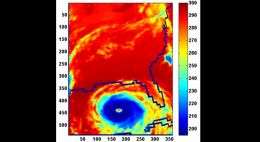
Extremely high clouds, known as deep convective clouds, are typically associated with severe storms and rainfall. In this AIRS image of Hurricane Katrina, taken August 28, 2005, the day before Katrina made landfall in Louisiana, the eye of the storm was surrounded by a "super cluster" of 528 deep convective clouds (depicted in dark blue). The temperatures of the tops of such clouds are colder than 210 degrees Kelvin (-82 degrees Fahrenheit). Image credit: NASA/JPL

(PhysOrg.com) -- The frequency of extremely high clouds in Earth's tropics -- the type associated with severe storms and rainfall -- is increasing as a result of global warming, according to a study by scientists at NASA's Jet Propulsion Laboratory, Pasadena, Calif.

In a presentation today to the fall meeting of the American Geophysical Union in San Francisco, JPL Senior Research Scientist Hartmut Aumann outlined the results of a study based on five years of data from the Atmospheric Infrared Sounder (AIRS) instrument on NASA's Aqua spacecraft. The AIRS data were used to observe certain types of tropical clouds linked with severe storms, torrential rain and hail. The instrument typically detects about 6,000 of these clouds each day. Aumann and his team found a strong correlation between the frequency of these clouds and seasonal variations in the average sea surface temperature of the tropical oceans.

For every degree Centigrade (1.8 degrees Fahrenheit) increase in average ocean surface temperature, the team observed a 45-percent increase in the frequency of the very high clouds. At the present rate of global warming of 0.13 degrees Celsius (0.23 degrees Fahrenheit) per decade, the team inferred the frequency of these storms can be expected to increase by six percent per decade.

Climate modelers have long speculated that the frequency and intensity of severe storms may or may not increase with global warming. Aumann said results of the study will help improve their models.

"Clouds and rain have been the weakest link in climate prediction," said Aumann. "The interaction between the daytime warming of the sea surface under clear-sky conditions and increases in the formation of low clouds, high clouds and, ultimately, rain is very complicated. The high clouds in our observations—typically at altitudes of 20 kilometers (12 miles) and higher—present the greatest difficulties for current climate models, which aren't able to resolve cloud structures smaller than about 250 kilometers (155 miles) in size."

Aumann said the results of his study, published recently in Geophysical Research Letters, are consistent with another NASA-funded study by Frank Wentz and colleagues in 2005. That study found an increase in the global rain rate of 1.5 percent per decade over 18 years, a value that is about five times higher than the value estimated by climate models that were used in the 2007 report of the Intergovernmental Panel on Climate Change.

Provided by JPL/NASA

Explore further: Astonishing hi-resolution satellite views of the destruction from the Moore, Oklahoma tornado

add to favorites email to friend print save as pdf

Related Stories

Pandora posts in-line 1Q loss, upbeat sales

8 hours ago

(AP)—Internet radio company Pandora reported higher-than-expected revenue in the latest quarter, with losses in line with analysts' forecasts, as the number of subscribers who pay for ad-free listening rose above 2.5 million.

Google Drive sports new view and scan enhancements

8 hours ago

(Phys.org) —Google Drive has a new look and functions. The makeover in Google Drive features scanning and interface enhancements that put the user into "card" mode. The enhancements make it easy for the ...

Researcher admits mistakes in stem cell study

8 hours ago

A blockbuster study in which US researchers reported that they had turned human skin cells into embryonic stem cells contained errors, its lead author has acknowledged. ...

Recommended for you

Strong earthquake at exceptional depth

15 hours ago

This morning at 05:45 CEST, the earth trembled beneath the Okhotsk Sea in the Pacific Northwest. The quake, with a magnitude of 8.2, took place at an exceptional depth of 605 kilometers. Because of the great ...

Marine forecasting on the horizon for Indian Ocean Rim

16 hours ago

Nearly all of the member countries of the Indian Ocean Rim Association for Regional Cooperation (IOR-ARC) will attend the week-long workshop to further cooperation and understanding on international ocean ...

Russia evacuates drifting Arctic research station

May 23, 2013

Russia has ordered the urgent evacuation of the 16-strong crew of a drifting Arctic research station after ice floe that hosts the floating laboratory began to disintegrate, officials said Thursday.

User comments : 5

Adjust slider to filter visible comments by rank

Display comments: newest first

GrayMouser
3.7 / 5 (7) Dec 19, 2008
"based on five years of data"
The cycle for hurricanes is longer than that.
Nartoon
2.5 / 5 (8) Dec 19, 2008
I wish these 'learned' scientists would get their story straight, some, as above say increasing storms, while other AGW supporters say no to increased storms, and with the so called AGW over the last 50 years why have major hurricanes and tornadoes actually decreased?
anonperson
3.3 / 5 (6) Dec 20, 2008
why have major hurricanes and tornadoes actually decreased?

Where's your evidence for this quote?
Velanarris
3.4 / 5 (5) Dec 22, 2008
why have major hurricanes and tornadoes actually decreased?

Where's your evidence for this quote?

Pacific basin shows great reduction, indian basin shows great reduction.

The only increase is in the atlantic and that's by 1 storm per year. The trend is down, according to NOAA and CSIRO.
Velanarris
4 / 5 (4) Dec 23, 2008
Also here are a few interesting graphs for the North Atlantic Hurricane ACE charts.

Here's the ACE from 1944-2008 where 2008 is a slightly above average year:

http://www.coaps....2008.jpg

Now if you look at a grpah of the PDO, (unfortunately I can't find one that isn't horribly marred with propaganda from either side of the discussion) there is a rather distinct correlation showing that the cooling phase of the PDO heralds a decline in hurricane ACE as is expected by most theories. Since we're entering this cooling trend and hurricane ace appears to be declining from it's average over the warm PDO phase, I'd say that the conditions of the water have a far greater effect on hurricane ACE than air temp or co2 content ever could. This would be further supported by a continuing downward trend in hurricane activity over the next few years.

More news stories

Galaxies fed by funnels of fuel

(Phys.org) —Computer simulations of galaxies growing over billions of years have revealed a likely scenario for how they feed: a cosmic version of swirly straws.

Dark, massive asteroid to fly by Earth on May 31

It's 1.7 miles long. Its surface is covered in a sticky black substance similar to the gunk at the bottom of a barbecue. If it impacted Earth it would probably result in global extinction. Good thing it is ...

Source of life running out: water scientists

The majority of people on Earth people will face severe water shortages within a generation or two if pollution and waste continues unabated, scientists warned at a conference in Bonn Friday.

Google eyes emerging markets networks

Google has become deeply involved in a series of projects to build and operate wireless networks in emerging markets including sub-Saharan Africa and Southeast Asia, a report said Friday.