A sparkling spray of stars
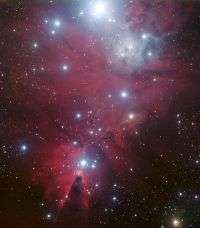
NGC 2264 lies about 2600 light-years from Earth in the obscure constellation of Monoceros, the Unicorn, not far from the more familiar figure of Orion, the Hunter. The image shows a region of space about 30 light-years across.
William Herschel discovered this fascinating object during his great sky surveys in the late 18th century. He first noticed the bright cluster in January 1784 and the brightest part of the visually more elusive smudge of the glowing gas clouds at Christmas nearly two years later. The cluster is very bright and can easily be seen with binoculars. With a small telescope (whose lenses will turn the view upside down) the stars resemble the glittering lights on a Christmas tree. The dazzling star at the top is even bright enough to be seen with the unaided eye. It is a massive multiple star system that only emerged from the dust and gas a few million years ago.
As well as the cluster there are many interesting and curious structures in the gas and dust. At the bottom of the frame, the dark triangular feature is the evocative Cone Nebula, a region of molecular gas flooded by the harsh light of the brightest cluster members. The region to the right of the brightest star has a curious, fur-like texture that has led to the name Fox Fur Nebula.
Much of the image appears red because the huge gas clouds are glowing under the intense ultra-violet light coming from the energetic hot young stars. The stars themselves appear blue as they are hotter, younger and more massive than our own Sun. Some of this blue light is scattered by dust, as can be seen occurring in the upper part of the image.
This intriguing region is an ideal laboratory for studying how stars form. The entire area shown here is just a small part of a vast cloud of molecular gas that is in the process of forming the next generation of stars. Besides the feast of objects in this picture there are many interesting objects hidden behind the murk of the nebulosity. In the region between the tip of the Cone Nebula and the brightest star at the top of the picture there are several stellar birthing grounds where young stars are forming. There is even evidence of the intense stellar winds from these youthful embryos blasting out from the hidden stars in the making.
This picture of NGC 2264, including the Christmas Tree Cluster, was created from images taken with the Wide Field Imager (WFI), a specialised astronomical camera attached to the 2.2-metre Max-Planck Society/ESO telescope at the La Silla observatory in Chile. Located nearly 2400 m above sea level, in the mountains of the Atacama Desert, ESO's La Silla enjoys some of the clearest and darkest skies on the whole planet, making the site ideally suited for studying the farthest depths of the Universe. To make this image, the WFI stared at the cluster for more than ten hours through a series of specialist filters to build up a full colour image of the billowing clouds of fluorescing hydrogen gas.
Source: ESO


