Dutch research into fair-weather clouds important in climate predictions
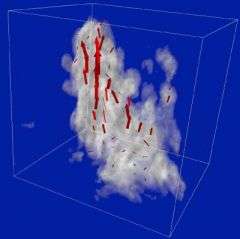
Research at the Delft University of Technology (The Netherlands) has led to better understanding of clouds, the unknown quantity in current climate models. The Delft researcher Thijs Heus has tackled this issue with a combination of detailed computer simulations and airplane measurements. He charted data including cloud speed, temperature and the 'life span' of clouds to arrive at new observations.
The behaviour of clouds is the great unknown quantity in current climate models. To make reliable predictions on climate change, more knowledge about clouds is thus essential. Heus explains, 'What we call fair-weather clouds have posed one of the biggest challenges in atmospheric science for decades. For accurate representation of clouds in weather and climate models, it is crucial to have a solid understanding of the interaction between clouds and the environment. Today, with the help of better observational methods and more powerful computers, we can get a much nicer picture of how it works.'
Heus continues, 'A cloud is normally described as an entity in which air rises. All around the cloud, air sinks downward in compensation for the upward movement.
'We demonstrated that air far away from the cloud on average displaces very little. The biggest amount of compensatory downward flow occurs immediately surrounding the cloud, in a ring of sinking air. This ring results because cloud air mixes with the surroundings, causing the cloud water to evaporate, air to cool, and thereby sink. The interaction between the cloud and its environment as such occurs indirectly, through the buffer zone of the ring. This buffer zone has not yet been incorporated into climate models until now.
'The ring is principally created by horizontal mixing. We showed that whatever happens on the cloud top has little influence on the underlying layers.'
A cloud's behaviour is likewise affected over time by this same horizontal mixing; the air in a cloud appears not to rise continuously, but rather in bubble-shaped form. Using visualizations in a Virtual Reality-environment, Heus could reliably research this tendency for the first time.
The Royal Netherlands Meteorological Institute (KNMI), Heus' current employer, and other scientific institutes have already expressed interest in the results of his study.
Source: Delft University of Technology


