Mysterious nanobubble burst?
Dec 02, 2008
Mysterious nanobubble burst?
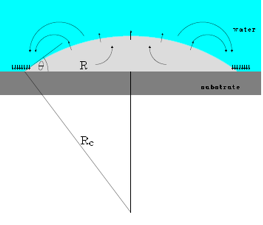
A bubble on the surface (radius R, contact angle θ); at the edges gas flows inwards and achieves an equilibrium with the outflow of gas. This results in a bubble that can remain intact for a long time.

(PhysOrg.com) -- The nanobubbles that develop on submerged surfaces should not really be able to exist. Because of the enormous internal pressure, they should disappear within a short time. Nevertheless, they sometimes last for hours: an unexplained phenomenon.

Professor Detlef Lohse of the University of Twente and his colleague Professor Michael Brenner of Harvard have, however, revealed something of interest. They demonstrated that an equilibrium can develop between the gas that leaves the bubble and the gas that flows into it. It is even possible to calculate the dimensions of a bubble in which this happens. The researchers’ work is being published in Physical Review Letters at the end of November.

The fact that bubbles can develop on a water-repellent surface, submerged in water, had already been demonstrated: these are the round ‘caps’ (see figure) with a diameter of about 100 nanometres and a height of 10 nanometres. The reason they develop is still a mystery but they are nevertheless useful: for example, liquids flow more easily, more rapidly and with less energy consumption along surfaces covered with bubbles. The first techniques for stimulating bubble formation have already been developed as well.

Equilibrium

Nevertheless, it is frustrating that there is still no explanation of how nanobubbles exist. Why should they develop? Small gas bubbles should dissolve rapidly because of the immense internal pressure, the gas flowing out of the bubble. They should disappear within microseconds, whereas measurements have shown that they can last for hours. Lohse and Brenner are searching for the reason why gas flows out of the bubble and, at the same time, inwards. When the two forces are in equilibrium, the bubble can remain intact for much longer than was first thought possible.

According to their theory, the inward flow takes place at the edge of the bubble; in other words, where the edge of a bubble comes in contact with a hydrophobic surface. It is known that, close to a hydrophobic surface, there is a higher concentration of gas molecules: these are then attracted by the surface. If these molecules now flow in via the edge of a bubble, they can reach a state of equilibrium with the molecules that are coming out of the bubble. This equilibrium is actually unstable: according to the second law of thermodynamics, this should only be a transitional phase, implying that the bubbles will dissolve within hours or perhaps days.

The theory, presented in Physical Review Letters, explains the long life of the bubbles. However, the researchers would like to look further into the long-term behaviour of these bubbles. Is the equilibrium unstable after all? Besides this, the new insights help with artificial stimulation of bubbles at the surface, for example, by means of electrolysis.

More information: link.aps.org/abstract/PRL/v101/e214505

Provided by University of Twente, Netherlands

Explore further: A breakthrough in plasmonics

add to favorites email to friend print save as pdf

Related Stories

Snowden's life surrounded by spycraft

15 hours ago

In the suburbs edged by woods midway between Baltimore and the U.S. capital, residents long joked that the government spy shop next door was so ultra-secretive its initials stood for "No Such Agency." But ...

Winners and losers at this week's E3

15 hours ago

Since the first battles over "Pong" machines in local arcades four decades ago, video gamers have loved good competition. And this year's Electronic Entertainment Expo—the industry's largest annual gathering—presented ...

Europe's space truck docks with ISS

15 hours ago

A robot freighter bearing 6.6 tonnes of cargo docked with the International Space Station (ISS) on Saturday, the European Space Agency (ESA) said.

Secret to Prism program: Even bigger data seizure

15 hours ago

In the months and early years after the Sept. 11, 2001, terrorist attacks, FBI agents began showing up at Microsoft Corp. more frequently than before, armed with court orders demanding information on customers.

Recommended for you

3D printing tiny batteries

5 hours ago

(Phys.org) —3D printing can now be used to print lithium-ion microbatteries the size of a grain of sand. The printed microbatteries could supply electricity to tiny devices in fields from medicine to communications, ...

World's most powerful microscope ready for research

10 hours ago

(Phys.org) —The world's most powerful microscope, which resides in a specially constructed room at the University of Victoria, has now been fully assembled and tested, and has a lineup of scientists and businesses eager ...

Future looks bright for carbon nanotube solar cells

10 hours ago

(Phys.org) —In an approach that could challenge silicon as the predominant photovoltaic cell material, University of Wisconsin-Madison materials engineers have developed an inexpensive solar cell that exploits ...

A breakthrough in plasmonics

Jun 17, 2013

EPFL scientists have discovered how optical signal transmission can be controlled, paving the way for the integration of plasmonics with conventional electronic circuits.

User comments : 1

Adjust slider to filter visible comments by rank

Display comments: newest first

guiding_light
not rated yet Dec 04, 2008
You know what I'm thinking; what does this mean for those hydrophobic materials used for immersion lithography?

More news stories

3D printing tiny batteries

(Phys.org) —3D printing can now be used to print lithium-ion microbatteries the size of a grain of sand. The printed microbatteries could supply electricity to tiny devices in fields from medicine to communications, ...

Future looks bright for carbon nanotube solar cells

(Phys.org) —In an approach that could challenge silicon as the predominant photovoltaic cell material, University of Wisconsin-Madison materials engineers have developed an inexpensive solar cell that exploits ...

Hybrid material as gold-leaf substitute

(Phys.org) —A team of researchers headed by Professor Raffaele Mezzenga has created a hybrid material out of gold and milk proteins that looks like a wafer-thin gold leaf. Thanks to its properties, it could ...

World's most powerful microscope ready for research

(Phys.org) —The world's most powerful microscope, which resides in a specially constructed room at the University of Victoria, has now been fully assembled and tested, and has a lineup of scientists and businesses eager ...