The Relativistic Heavy Ion Collider Makes Some Noise
Nov 21, 2008 By Laura Mgrdichian feature
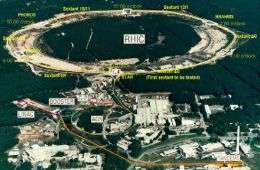
An aerial view of the Relativistic Heavy Ion Collider (RHIC) at the Brookhaven National Laboratory in Upton, NY. Image: AIP

(PhysOrg.com) -- A group of physicists studying heavy-ion collisions at the Relativistic Heavy Ion Collider (RHIC), a large particle accelerator located on Long Island, New York, recently showed that the collisions can create acoustic shock waves -- sonic booms. This new information could be used to learn even more about the intriguing state of matter produced during the collisions.

The matter, known as a quark-gluon plasma, is produced because the collisions are so energetic and hot that the ions' constituent particles, quarks and gluons -- known collectively as partons -- which are normally tightly bound together, "melt" into a fluid-like particle soup.

"What does a quark gluon plasma sound like? We wanted to find out," said Duke University physicist Bryon Neufeld to PhysOrg.com, the paper's corresponding author. "Sound waves are commonly used as a probe of everyday matter. But sound may also be a useful tool for researching matter at temperatures many thousands of times hotter than the sun.

"Our work addresses the question of sound from a different perspective: What is the sound generated by highly energetic particles moving through the quark-gluon plasma, and how can we use it to explore the properties of the plasma?"

Neufeld co-authored the paper on this research, appearing in the October 13 edition of Physical Review C, with physicists Berndt Mueller (Duke University) and Jorg Ruppert (McGill University, Montreal, Canada and J. W. Goethe-Universitat, Frankfurt, Germany).

The group was looking for evidence of a Mach cone -- the cone-shaped shock wave caused by the pressure difference created when an object, like an airplane or particle, exceeds the speed of sound in that particular medium (the speed of sound is different in different media).

Said Neufeld, "Highly energetic particles traveling faster than the speed of sound may produce characteristic sound patterns, such as Mach cones, which create distinctive experimental signatures. These experimental signatures can help determine certain characteristics of the medium they are traveling through, such as the speed of sound and viscosity."

After the heavy-ion beams collide (in this case the beams consisted of either gold or lead nuclei), some partons back-scatter into the plasma rather than out of it. The physicists modeled the case of a single parton moving through the plasma, depositing energy and momentum in its wake. They took that model and used it to solve the hydrodynamic equations of the plasma. The solutions show that, mathematically, if the parton is moving faster than the speed of sound in the plasma a Mach cone trails behind it.

Citation: Phys. Rev. C 78, 041901 (2008)

Copyright 2008 PhysOrg.com.
All rights reserved. This material may not be published, broadcast, rewritten or redistributed in whole or part without the express written permission of PhysOrg.com.

Explore further: New X-ray method shows how frog embryos could help thwart disease

add to favorites email to friend print save as pdf

Related Stories

VISIONS: Seeing the aurora in a new light

Feb 01, 2013

On a cold February night in Poker Flat, Alaska, a team of scientists will wait patiently for the exotic red and green glow of an aurora to illuminate the sky. Instead of simply admiring the view, this group ...

Mankind's messenger at the final frontier

Sep 05, 2012

It looks like a dustbin lid strapped to a cluster of fishing rods. Its computer is so puny it could not even start up your iPhone. And if E.T. wants to listen to the message it brings, he'll need a gramophone ...

Heliophysics nugget: Riding the plasma wave

Jul 18, 2012

Throughout the universe more than 99 percent of matter looks nothing like what's on Earth. Instead of materials we can touch and see, instead of motions we intuitively expect like a ball rolling down a hill, ...

Recommended for you

Bringing life into focus

May 17, 2013

Spinning-disk confocal microscopy is an optical imaging technique that can be used to generate detailed three-dimensional fluorescence images of living cells and their contents. Although a powerful tool for ...

World's smallest droplet

May 17, 2013

(Phys.org) —Physicists may have created the smallest drops of liquid ever made in the lab. That possibility has been raised by the results of a recent experiment conducted by Vanderbilt physicist Julia Velkovska and her ...

User comments : 2

Adjust slider to filter visible comments by rank

Display comments: newest first

dvoss
3 / 5 (2) Nov 21, 2008
In regards your story
http://www.physor...980.html
readers may also be interested in the
commentary that accompanied the article in
Physical Review C at
http://physics.ap...es/v1/29
Readers who come in via this commentary can
access the PRC article for free.
Absolute
not rated yet Apr 28, 2009
Real Quark-Gluon Plasma Model 100% clearer than RHIC output
Recently, we have discovered a new process that can propose better outputs of Quark-Gluon Plasma than those of the RHIC. Mr.Tepparat Songkraw, a creator of this model, entitles his process as %u201CRelativistic Electron Repetition%u201D or %u201CRER%u201D. Its outputs are called Absolute Quark-Gluon Plasma model which is a part of Absolute Plasmon model.
Its images can be illustrated as follows:
http://www.absolutebase.com

More news stories

New principle may help explain why nature is quantum

Like small children, scientists are always asking the question 'why?'. One question they've yet to answer is why nature picked quantum physics, in all its weird glory, as a sensible way to behave. Researchers ...

Manipulating Lorentz and Fano spectral line shapes

(Phys.org) —It is widely known that the optical properties of certain materials can be modified by using lasers to control the quantum states of their optical electrons. Lasers that can generate ultra-short ...