Chandrayaan-1 now in lunar orbit
Nov 10, 2008
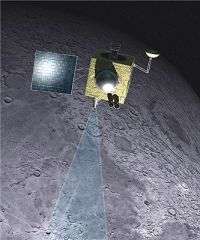
This artist's concept shows the Indian lunar orbiter Chandrayaan-1. The spacecraft will carry two European experiments on board which are direct descendents of ESA's SMART-1 - the infrared spectrometer, SIR2, and the X-ray spectrometer, C1XS, to study the mineralogy and the chemical composition of the lunar surface. The third European instrument on board is the SARA Sub-kiloelectronvolt Atom Reflecting Analyser, that will study the interaction between the lunar surface and the solar wind. Credits: ISRO

(PhysOrg.com) -- Chandrayaan-1, the Indian Space Research Organisation’s (ISRO) lunar orbiter, was captured into orbit around the Moon on 8 November. One day later, the spacecraft performed a manoeuvre that lowered the closest point of its orbit down to 200 km from the Moon.

The spacecraft’s liquid-fuel propelled engine was fired at 12:21 CET (16:51 Indian Standard Time) when it was at a distance of about 500 km from the Moon. This reduced the spacecraft’s velocity, enabling the Moon’s gravitational field to capture Chandrayaan-1 into lunar orbit. In this configuration, the orbit’s point closest to the lunar surface was at 504 km and the spacecraft circled the Moon in 11 hours.

This lunar orbit insertion manoeuvre was executed from the Chandrayaan-1 Spacecraft Control Centre at ISRO’s Telemetry, Tracking and Command Network at Bangalore. The performance of all the systems on board Chandrayaan-1 was registered as normal.

Yesterday, at 15:33 CET (20:03 Indian Standard Time), the spacecraft’s engine was fired for about 57 seconds, reducing the orbit’s point closest to the lunar surface to 200 km while the farthest point remained unchanged at 7502 km. In this elliptical orbit, Chandrayaan-1 takes about ten and a half hours to circle the Moon once.

Over the next few days, the height of the spacecraft’s orbit around the Moon will be carefully reduced in steps to achieve a final 100-km polar lunar orbit. The Moon Impact Probe (MIP) will then be released to hit the lunar surface, after which the other instruments on board will be turned on.

Chandrayaan-1 was launched on 22 October by from India’s spaceport at Satish Dhawan Space Centre SHAR, Sriharikota. The launcher placed the spacecraft in an elliptical orbit around Earth.

In the past two weeks, the Terrain Mapping Camera (TMC), one of the eleven scientific instruments of the spacecraft, was successfully operated twice to take pictures.

Provided by ESA

Explore further: Field tests in Mojave Desert pave way for human exploration of small bodies

add to favorites email to friend print save as pdf

Related Stories

Recommended for you

Mars rover Opportunity examines clay clues in rock

14 hours ago

(Phys.org) —NASA's senior Mars rover, Opportunity, is driving to a new study area after a dramatic finish to 20 months on "Cape York" with examination of a rock intensely altered by water.

NASA's STEREO detects a CME from the sun

May 17, 2013

On 5:24 a.m. EDT on May 17, 2013, the sun erupted with an Earth-directed coronal mass ejection or CME, a solar phenomenon that can send billions of tons of solar particles into space that can reach Earth ...

Nine-year-old Mars rover passes 40-year-old record

May 17, 2013

While Apollo 17 astronauts Eugene Cernan and Harrison Schmitt visited Earth's moon for three days in December 1972, they drove their mission's Lunar Roving Vehicle 19.3 nautical miles (22.210 statute miles ...

Bright explosion on the Moon

May 17, 2013

For the past 8 years, NASA astronomers have been monitoring the Moon for signs of explosions caused by meteoroids hitting the lunar surface. "Lunar meteor showers" have turned out to be more common than anyone ...

User comments : 0

More news stories

Galaxy's Ring of Fire

Johnny Cash may have preferred this galaxy's burning ring of fire to the one he sang about falling into in his popular song. The "starburst ring" seen at center in red and yellow hues is not the product of ...

Alaska volcano shoots ash 15,000 feet into the air

(AP)—One of Alaska's most restless volcanoes has shot an ash cloud 15,000 feet into the air in an ongoing eruption that has drawn attention from a nearby community but isn't expected to threaten air traffic.

Chinese, Indian airlines face EU pollution fines

Eight Chinese and two Indian airlines face fines of up to several million euros for not paying for their greenhouse gas emissions during flights within the bloc, the European Commission said on Friday.

Morocco to harness the wind in energy hunt

Morocco is ploughing ahead with a programme to boost wind energy production, particularly in the southern Tarfaya region, where Africa's largest wind farm is set to open in 2014.

US seizes Bitcoin operator accounts

US authorities seized the accounts of a Bitcoin digital currency exchange operator, claiming it was functioning as an "unlicensed money service business," court documents showed Friday.