The Good Vibrations of Nearby Stars
Oct 23, 2008
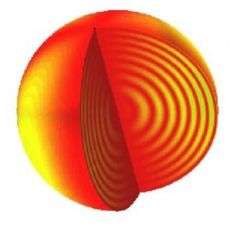
Illustration of a stellar global oscillation shaking the whole star interior and thus carrying information on it. Yellow refers to maximum temperature variations due to oscillations. Image courtesy of Aarhus University/S. Frandsen

Some of the first data collected by the CoRoT space telescope mission, launched in December 2006, provides valuable information about the physical vibrations and surface characteristics of nearby stars that are similar to our Sun, researchers say. This novel information illustrates the great value of space-based observations, and provides astronomers with insights into the interior of our Sun, other stars, and the overall evolution of our galaxy.

The related report will be published by the journal Science on Friday, 24 October, and featured on the cover. Science is the journal of AAAS, the nonprofit science society.

Dr. Eric Michel from the Observatory of Paris-LESIA-CNRS and a large group of colleagues from across Europe and South America analyzed the data from the CoRoT satellite to determine that three nearby stars, all significantly hotter than the Sun, also have larger vibrations, or oscillations, and much finer surface texture, or granulation. With this unprecedented data, the researchers show that the stars' oscillations are about 1.5 times as vigorous as the Sun's, and their granulation is about three times finer. The observed oscillations, though much more intense than the Sun's, are still about 25% weaker than most models predicted.

These landmark results represent the first time researchers have been able to accurately gauge the oscillation amplitudes and granulation signatures of solar bodies in our universe, other than the Sun.

The initial discovery of oscillations in our Sun in the late 1970's led to the creation of "solar seismology," which has since been used to measure the movement and transport of heat around the Sun. Solar seismology led to rapid progress in understanding the Sun's internal structure, but eventually researchers hit a wall. Accurate measurements of solar-like oscillations require the collection of precise data from long, uninterrupted sequences of observations, making ground-based study impossible.

"Although the energy from the Sun is more or less constant over our lifetimes, even very small variability in its output can have important effects," says Brooks Hanson, deputy editor for physical sciences at Science Magazine. "Understanding that small variability is critical, for example, in predicting solar storms and space weather, and for resolving the causes of changes in Earth's climate… These observations [by Michel and colleagues], and more in the future, will provide the essential data for improving our understanding of the interior of the Sun, and stars in general."

The findings presented by Michel and colleagues are based on light curves obtained with the CoRoT satellite over a period of 60 days, and help to refine our understanding of stars and the Sun. These results "allow us to place our Sun within the bigger picture of the evolution of our galaxy and the local universe," says Ian Osborne, senior editor of Science Magazine.

Source: American Association for the Advancement of Science

Explore further: Detection of the cosmic gamma ray horizon: Measures all the light in the universe since the Big Bang

add to favorites email to friend print save as pdf

Related Stories

The nuclear reactor in your basement

Feb 19, 2013

How would you like to replace your water heater with a nuclear reactor? That's what Joseph Zawodny, a senior scientist at NASA's Langley Research Center, hopes to help bring about. It would tap the enormous ...

New research brings light to star mystery

Feb 04, 2013

(Phys.org)—Scientists at Northumbria University have begun to unlock the mystery of why the outer edge of the Sun is much hotter than its surface for the first time.

Solar and wind energy may stabilise the power grid

Sep 14, 2012

(Phys.org)—Renewable energies such as wind, sun and biogas are set to become increasingly important in generating electricity. If increasing numbers of wind turbines and photovoltaic systems feed electrical ...

A star’s dying scream may be a beacon for physics

Aug 14, 2012

When a star suffered an untimely demise at the hands of a hidden black hole, astronomers detected its doleful, ululating wail — in the key of D-sharp, no less — from 3.9 billion light-years away. ...

Recommended for you

Hubble reveals the ring nebula's true shape

20 hours ago

(Phys.org) —The Ring Nebula's distinctive shape makes it a popular illustration for astronomy books. But new observations by NASA's Hubble Space Telescope of the glowing gas shroud around an old, dying, ...

A hidden population of exotic neutron stars

May 23, 2013

(Phys.org) —Magnetars – the dense remains of dead stars that erupt sporadically with bursts of high-energy radiation - are some of the most extreme objects known in the Universe. A major campaign using ...

User comments : 0

More news stories

Dark, massive asteroid to fly by Earth on May 31

It's 1.7 miles long. Its surface is covered in a sticky black substance similar to the gunk at the bottom of a barbecue. If it impacted Earth it would probably result in global extinction. Good thing it is ...

Source of life running out: water scientists

The majority of people on Earth people will face severe water shortages within a generation or two if pollution and waste continues unabated, scientists warned at a conference in Bonn Friday.

ACOG: Hormone therapy not recommended to prevent CHD

(HealthDay)—Menopausal hormone therapy should not be used for prevention of coronary heart disease, according to a Committee Opinion from the American College of Obstetricians and Gynecologists (ACOG) published ...

Storm chasers: born to be wild?

(HealthDay)—We've all seen them: the surfers who race to the beach when a hurricane hits, the guy who decides to ride out the storm in his overmatched boat, the tornado chasers who fearlessly steer their ...