Cosmic eye sheds light on early galaxy formation
Oct 08, 2008
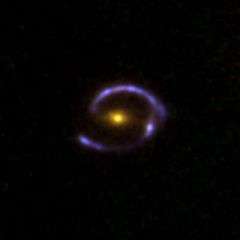
The Cosmic Eye, showing the foreground galaxy in yellow at the centre of the image surrounded by the blue arc of the distant galaxy. Credit: Mark Swinbank/Durham University

A Cosmic Eye has given scientists a unique insight into galaxy formation in the very early Universe. Using gravity from a foreground galaxy as a zoom lens the team was able to see a young star-forming galaxy in the distant Universe as it appeared only two billion years after the Big Bang.

Scientists at the California Institute of Technology (Caltech), USA, and Durham University and Cardiff University, UK, are behind the research published today in the prestigious scientific journal Nature.

The researchers, led by Dr Dan Stark, of Caltech, say their findings show for the first time how the distant galaxy might evolve to become a present-day system like our Milky Way.

And they say their study also provides a taste of what astronomers will be able to see in the distant Universe once projects such as the planned European Extremely Large Telescope (E-ELT) and the American Thirty Metre Telescope (TMT) come into use.

The Cosmic Eye is so called because the foreground galaxy, which is 2.2 billion light years from Earth, appears in the centre of an arc created by the distant galaxy – giving it the appearance of a human eye.

The distant galaxy, which lies 11 billion light years from Earth, was originally identified using the Hubble Space Telescope.

The team then used the ten metre Keck telescope, on Hawaii, which is equipped with laser-assisted guide star adaptive optics (AO) to correct for blurring in the Earth's atmosphere, to carry out their observations.

By coupling the telescope with the magnifying effect of the gravitational field of the foreground galaxy – a technique called gravitational lensing - they were able to study the distant star system.

Gravitational lensing, the distortion of light rays by massive objects as predicted by Einstein, enlarged the distant galaxy by eight times.

This allowed the scientists to determine the galaxy's internal velocity structure and compare it to later star systems such as the Milky Way.

Research co-author Dr Mark Swinbank, in The Institute for Computational Cosmology, at Durham University, said: "This is the most detailed study there has been of an early galaxy. Effectively we are looking back in time to when the Universe was in its very early stages.

"This technique of using gravitational lensing provides us with a glimpse of what we will commonly achieve when the next generation of telescopes, which are still a decade away, come on-line."

Dr Dan Stark, of Caltech, said: "Gravity has effectively provided us with an additional zoom lens, enabling us to study this distant galaxy on scales approaching only a few hundred light years.

"This is ten times finer sampling than previously. As a result for the first time we can see that a typical-sized young galaxy is spinning and slowly evolving into a spiral galaxy much like our own Milky Way."

Data from the Keck Observatory was combined with millimetre observations from the Plateau de Bure Interferometer, in the French Alps, which is sensitive to the distribution of cold gas destined to collapse to form stars.

Dr Swinbank added: "Remarkably the cold gas traced by our millimetre observations shares the rotation shown by the young stars in the Keck observations.

"The distribution of gas seen with our amazing resolution indicates we are witnessing the gradual build up of a spiral disk with a central nuclear component."

Source: Durham University

Explore further: Galaxy's Ring of Fire

add to favorites email to friend print save as pdf

Related Stories

Thermal shield testing on Webb's MIRI

May 09, 2013

(Phys.org) —NASA engineer Acey Herrera recently checked out copper test wires inside the thermal shield of the Mid-Infrared Instrument, known as MIRI, that will fly aboard NASA's James Webb Space Telescope. ...

Sifting through the atmospheres of far-off worlds

May 09, 2013

(Phys.org) —Gone are the days of being able to count the number of known planets on your fingers. Today, there are more than 800 confirmed exoplanets—planets that orbit stars beyond our sun—and more ...

'Space warps' project needs your help

May 08, 2013

(Phys.org) —Astronomers are asking volunteers to help them search for "space warps." More commonly known as "gravitational lenses," these are rare systems with very massive galaxies or clusters of galaxies that bend light ...

Eyeball earths

May 03, 2013

Alien worlds resembling giant eyeballs might exist around red dwarf stars, and researchers are now proposing experiments to simulate these distant planets and see how capable they are of supporting life.

Recommended for you

Galaxy's Ring of Fire

3 hours ago

Johnny Cash may have preferred this galaxy's burning ring of fire to the one he sang about falling into in his popular song. The "starburst ring" seen at center in red and yellow hues is not the product of ...

4C+29.30: Black hole powered jets plow into galaxy

May 15, 2013

(Phys.org) —This composite image of a galaxy illustrates how the intense gravity of a supermassive black hole can be tapped to generate immense power. The image contains X-ray data from NASA's Chandra X-ray ...

A space-time magnifying glass

May 15, 2013

(Phys.org) —Bright arcs are smeared around the heart of galaxy cluster Abell S1077 in this image taken by the NASA/ESA Hubble space telescope. The arcs are stretched images of distant galaxies distorted ...

User comments : 7

Adjust slider to filter visible comments by rank

Display comments: newest first

thales
4 / 5 (1) Oct 08, 2008
Wait till they figure out that's a picture of our actual Milky Way! Wouldn't that be awesome. Seriously though, this is a very exciting preview of what those future telescopes will be able to do.
nano999
not rated yet Oct 08, 2008

yyz
5 / 5 (1) Oct 08, 2008
A short , discovery paper on this weird system (aka LBG J213512.73-010143 , a Lyman Break Galaxy with a redshift of 3.07) was posted at arXiv:astro-ph/0611486 for Nov 15, 2006. It includes HST images & Keck spectra to help determine the physical characteristics of both the lensing galaxy (at a redshift of 0.73) & the magnified image of the LBG. Lensed systems such as this one can give astronomers valuable information on distant, forming galactic systems that would otherwise prove too faint to accurately examine due to their great distance. Websites such as the Strong Lenses COSMOS Page at http://cosmosstro...i-hd.de/ provide current images & info on these rare and unusual gravitational lenses and are frequently updated with current info & newly discovered objects. These systems not only provide good sources of information on chemical abundances, star formation rates and other physical characteristics of the lensed galaxies, but can also provide info on Dark Matter distribution in the lensing galaxies themselves. These systems are sure to be examined in detail across the entire electromagnetic spectrum in the coming years.A related search for lensed quasars, the SDSS Quasar Lens Search( SQLS ) can be found at http://www-utap.p...dex.html . Similar to the Strong Lenses COSMOS Page, current images & info on lensed quasars can be found here and the site is updated periodically with links to new images, info & newly discovered systems of this type. Both sites are highly recommended for those interested in gravitationally lensed systems and current research being performed on them
brant
1 / 5 (1) Oct 08, 2008
That is one system, not a lensed system.
They must base that on redshift!!
bobwinners
1 / 5 (1) Oct 13, 2008
Ok, I'd really like it if these people stopped referencing the 'beginning' of the universe and instead related their findings to current time/space. You know, like "13.5 B years ago". We really don't know how old the universe is or even if it has an age.
yyz
not rated yet Oct 13, 2008
@bobwinners, I see no mention of 'the beginning of the universe' or '13.5 B years ago' in the article above. Distances mentioned in the article are referenced to distance from Earth, based on their redshift. I think you missed the main point here, that these highly magnified distant galaxies can be probed & measured much more precisely due to the fact that they are gravitationally lensed. Unlensed galaxies or protogalaxies 11 billion l.y. from Earth would make hi-res spectra, color determinations, star-formation rates, etc. impossible due to faint their apparent magnitudes. If you have issues with the age or origin of the universe, this study does not address these issues. Carefully reread the article for what it actually states.
yyz
not rated yet Oct 15, 2008
I neglected to mention another galaxy lensing site updated regularly and containing many images of gravity lenses. The Cambridge And Sloan Survey of Wide Arcs in the skY( CASSOWARY ) can be found at http://www.ast.ca...sowary/. 23 objects are currently listed, some with spectra and followup information links. Quite an impressive collection.

More news stories

Galaxy's Ring of Fire

Johnny Cash may have preferred this galaxy's burning ring of fire to the one he sang about falling into in his popular song. The "starburst ring" seen at center in red and yellow hues is not the product of ...

Alaska volcano shoots ash 15,000 feet into the air

(AP)—One of Alaska's most restless volcanoes has shot an ash cloud 15,000 feet into the air in an ongoing eruption that has drawn attention from a nearby community but isn't expected to threaten air traffic.

Chinese, Indian airlines face EU pollution fines

Eight Chinese and two Indian airlines face fines of up to several million euros for not paying for their greenhouse gas emissions during flights within the bloc, the European Commission said on Friday.

Morocco to harness the wind in energy hunt

Morocco is ploughing ahead with a programme to boost wind energy production, particularly in the southern Tarfaya region, where Africa's largest wind farm is set to open in 2014.

US psychiatry gets makeover in new manual

The latest makeover to a massive psychiatric tome honored by some, reviled by others and even called the "Bible" of mental disorders is being released Saturday with a host of new changes.

US seizes Bitcoin operator accounts

US authorities seized the accounts of a Bitcoin digital currency exchange operator, claiming it was functioning as an "unlicensed money service business," court documents showed Friday.