'Little bang' triggered solar system formation
Oct 02, 2008
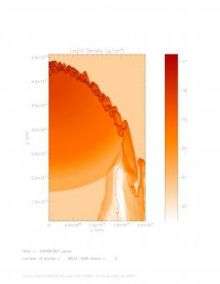
Cross-sectional view of one-half of a solar-mass target cloud being struck by a supernova shock front that is traveling downward. The colors represent the target cloud, with redder colors representing denser regions. The solid black contours delineate material that was originally in the supernova shock front, where short-lived radioisotopes are being injected into the collapsing target cloud.

For several decades, scientists have thought that the Solar System formed as a result of a shock wave from an exploding star—a supernova—that triggered the collapse of a dense, dusty gas cloud that contracted to form the Sun and the planets. But detailed models of this formation process have only worked under the simplifying assumption that the temperatures during the violent events remained constant. Now, astrophysicists at the Carnegie Institution's Department of Terrestrial Magnetism (DTM) have shown for the first time that a supernova could indeed have triggered the Solar System's formation under the more likely conditions of rapid heating and cooling. The results, published in the October 20, 2008, issue of the Astrophysical Journal, have resolved this long-standing debate.

"We've had chemical evidence from meteorites that points to a supernova triggering our Solar System's formation since the 1970s," remarked lead author, Carnegie's Alan Boss. "But the devil has been in the details. Until this study, scientists have not been able to work out a self-consistent scenario, where collapse is triggered at the same time that newly created isotopes from the supernova are injected into the collapsing cloud."

Short-lived radioactive isotopes—versions of elements with the same number of protons, but a different number of neutrons—found in very old meteorites decay on time scales of millions of years and turn into different (so-called daughter) elements. Finding the daughter elements in primitive meteorites implies that the parent short-lived radioisotopes must have been created only a million or so years before the meteorites themselves were formed. "One of these parent isotopes, iron-60, can be made in significant amounts only in the potent nuclear furnaces of massive or evolved stars," explained Boss. "Iron-60 decays into nickel-60, and nickel-60 has been found in primitive meteorites. So we've known where and when the parent isotope was made, but not how it got here."

Previous models by Boss and former DTM Fellow Prudence Foster showed that the isotopes could be deposited into a pre-solar cloud if a shock wave from a supernova explosion slowed to 6 to 25 miles per second and the wave and cloud had a constant temperature of -440 °F (10 K). "Those models didn't work if the material was heated by compression and cooled by radiation, and this conundrum has left serious doubts in the community about whether a supernova shock started these events over four billion years ago or not," remarked Harri Vanhala, who found the negative result in his Ph.D. thesis work at the Harvard-Smithsonian Center for Astrophysics in 1997.

Using an adaptive mesh refinement hydrodynamics code, FLASH2.5, designed to handle shock fronts, as well as an improved cooling law, the Carnegie researchers considered several different situations. In all of the models, the shock front struck a pre-solar cloud with the mass of our Sun, consisting of dust, water, carbon monoxide, and molecular hydrogen, reaching temperatures as high as 1,340°F (1000 K). In the absence of cooling, the cloud could not collapse. However, with the new cooling law, they found that after 100,000 years the pre-solar cloud was 1,000 times denser than before, and that heat from the shock front was rapidly lost, resulting in only a thin layer with temperatures close to 1,340°F (1000 K). After 160,000 years, the cloud center had collapsed to become a million times denser, forming the protosun. The researchers found that isotopes from the shock front were mixed into the protosun in a manner consistent with their origin in a supernova.

Source: Carnegie Institution

Explore further: Very Large Telescope celebrates 15 years of success

add to favorites email to friend print save as pdf

Related Stories

Swift, Chandra explore a youthful 'star wreck'

Mar 15, 2013

(Phys.org) —While performing an extensive X-ray survey of our galaxy's central regions, NASA's Swift satellite has uncovered the previously unknown remains of a shattered star. Designated G306.3.9 after ...

DEM L50: Stellar effervescence on display

Jan 28, 2013

(Phys.org)—This composite image shows the superbubble DEM L50 (a.k.a. N186) located in the Large Magellanic Cloud about 160,000 light years from Earth. Superbubbles are found in regions where massive stars ...

Fingering the culprit that polluted the Solar System

Aug 02, 2012

(Phys.org) -- For decades it has been thought that a shock wave from a supernova explosion triggered the formation of our Solar System. According to this theory, the shock wave also injected material from ...

Star explosion leaves behind a rose

Dec 12, 2011

(PhysOrg.com) -- About 3,700 years ago, people on Earth would have seen a brand-new bright star in the sky. It slowly dimmed out of sight and was eventually forgotten, until modern astronomers later found ...

Space image: New supernova remnant lights up

Sep 13, 2011

(PhysOrg.com) -- Using the Hubble Space Telescope, astronomers are witnessing the unprecedented transition of a supernova to a supernova remnant, where light from an exploding star in a neighboring galaxy, ...

Recommended for you

Very Large Telescope celebrates 15 years of success

3 hours ago

(Phys.org) —With this new view of a spectacular stellar nursery ESO is celebrating 15 years of the Very Large Telescope—the world's most advanced optical instrument. This picture reveals thick clumps ...

Fragile mega-galaxy is missing link in history of cosmos

20 hours ago

Two hungry young galaxies that collided 11 billion years ago are rapidly forming a massive galaxy about 10 times the size of the Milky Way, according to UC Irvine-led research published Wednesday in the journal ...

User comments : 1

Adjust slider to filter visible comments by rank

Display comments: newest first

vidyunmaya
1 / 5 (2) Oct 03, 2008
Sub: Image Interlinks-Cosmology Vedas- Trigger Mode
1.http://www.physor...544.html
2.Supernova Remnants Dance in the LMC
http://www.physor...263.html
Search my book:
Heart of the Universe-The Science in Philosophy-
©2007-TXu 1-364-245- Author Vidyardhi Nanduri
[ Pridhvi Viswam Asya DharineemCosmos yoga vision series-II- cover upto 10^5 Light Years-Centre of the Universe]

More news stories

Bacterium from Canadian High Arctic and life on Mars

(Phys.org) —The temperature in the permafrost on Ellesmere Island in the Canadian high Arctic is nearly as cold as that of the surface of Mars. So the recent discovery by a McGill University led team of ...

Researchers forward quest for quantum computing

Research teams from UW-Milwaukee and the University of York investigating the properties of ultra-thin films of new materials are helping bring quantum computing one step closer to reality.

Cold plasma successful against brain cancer cells

For the first time, physicists from the Max Planck Institute for Extraterrestrial Physics (MPE), biologists and physicians demonstrated the synergistic effect of cold atmospheric plasma - a partly ionized ...

Chemists find new compounds to curb staph infection

(Phys.org) —In an age when microbial pathogens are growing increasingly resistant to the conventional antibiotics used to tamp down infection, a team of Wisconsin scientists has synthesized a potent new ...