Europe all set for lunar mission Chandrayaan-1
Sep 25, 2008
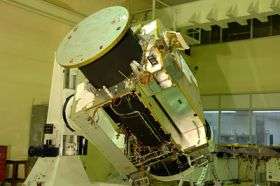
The Chandrayaan-1 spacecraft during integration. The payload panels, where the remote sensing instruments will be mounted, can be seen on the right. At the top, the interface panel for the Moon Impact Probe is shown where, among others, the SARA sensors will be mounted. At the time when this image was taken, only the SIR-2 instrument had been integrated. In this orientation, the Moon will be at the bottom of the spacecraft during observations. Credits: ISRO/ISAC

Europe is participating in a big way in the Indian Space Agency’s Chandrayaan-1 mission to the Moon, by contributing three instruments. All these instruments have now been delivered, tested and integrated with the spacecraft.

The Chandrayaan-1 spacecraft is now at the Indian Space Research Organisation, ISRO’s facilities in Bangalore, India. Delivery for each instrument is completed once the hardware physically arrives, has been integrated with the spacecraft, and the software interfaces are checked.

SIR-2, a near-infrared spectrometer was delivered in the first week of November last year. SARA, Sub-kilo electron volt Atom Reflecting Analyser, was delivered on 8 April 2008. Europe’s contribution is now complete as the Chandrayaan-1 X-ray Spectrometer (C1XS), the third instrument, was tested and integrated with the spacecraft on 22 August.

SIR-2 will survey the Moon’s geological composition and the effect of space weathering on its surface. Data from the instrument will be used to study the formation of the structures that exist on the Moon. SIR-2 is led by the Max-Planck Institute for Solar System science.

This instrument builds upon the infrared spectrometer (SIR), which flew on SMART-1. The combination of the improvements made and the low orbit of Chandrayaan-1 will enable superior scientific measurements.

SARA, led by the Swedish Institute of Space Physics, and developed with hardware contribution from the Space Physics Laboratory at the Vikram Sarabhai Space Centre, India, will measure the resulting atomic emission from interactions of the solar wind with the Moon’s surface.

“The experience with SARA will prepare us for a similar instrument on BepiColombo,” says Christian Erd, ESA’s Chandrayaan-1 Project Manager.

X-ray Spectroscopy of the Moon, the objective of C1XS, will yield information on the origin and evolution of our planet’s natural satellite. C1XS builds upon the legacy of the D-CIXS instrument that flew on board SMART-1, and consists of significant upgrades based on the experience gained with ESA’s lunar mission.

C1XS has been developed in collaboration between Rutherford Appleton Laboratory, UK and the ISRO Satellite Centre, with support from ESA.

Erd added, “SARA follows up on instruments used on board Mars and Venus Express and will be the first instrument to study plasma-surface interactions, while SIR-2 and C1XS build upon the legacy of SMART-1. The lessons we have learnt through experience will be put to good use with Chandrayaan-1.”

Chandrayaan-1’s low orbit will bring it very close to the Moon, returning data of a high quality.

“European scientists will have the fantastic opportunity to continue our work on the Moon,” added Detlef Koschny, ESA Chandrayaan-1 Project Scientist.

The integration of all instruments of the Chandrayaan-1 mission is now complete and validation tests to check the functionality of the spacecraft and the suite of instruments are underway.

Provided by ESA

Explore further: Mice, gerbils perish in Russia space flight

add to favorites email to friend print save as pdf

Related Stories

Bold action, big money needed to curb Asia floods

7 hours ago

Asia's flood-prone megacities should fund major drainage, water recycling and waste reduction projects to stem deluges and secure clean supply for their booming populations, experts said Sunday.

Heat-related deaths in Manhattan projected to rise

9 hours ago

Residents of Manhattan will not just sweat harder from rising temperatures in the future, says a new study; many may die. Researchers say deaths linked to warming climate may rise some 20 percent by the 2020s, ...

Dire outlook despite global warming 'pause': study

9 hours ago

A global warming "pause" over the past decade may invalidate the harshest climate change predictions for the next 50 to 100 years, a study said Sunday—though levels remain in the danger zone.

Kinks and curves at the nanoscale

9 hours ago

One of the basic principles of nanotechnology is that when you make things extremely small—one nanometer is about five atoms wide, 100,000 times smaller than the diameter of a human hair—they are going ...

Recommended for you

Proba-V opens its eyes

3 hours ago

(Phys.org) —Earth watcher Proba-V is in good health following its launch last week. The Vegetation imager has been switched on and the first image has been captured over western France.

Mice, gerbils perish in Russia space flight

May 19, 2013

A number of mice and eight gerbils sent into space in a Russian capsule destined to find out how well organisms can withstand extended flights perished during their journey, scientists said Sunday as the ...

Mars rover Opportunity examines clay clues in rock

May 18, 2013

(Phys.org) —NASA's senior Mars rover, Opportunity, is driving to a new study area after a dramatic finish to 20 months on "Cape York" with examination of a rock intensely altered by water.

NASA's STEREO detects a CME from the sun

May 17, 2013

On 5:24 a.m. EDT on May 17, 2013, the sun erupted with an Earth-directed coronal mass ejection or CME, a solar phenomenon that can send billions of tons of solar particles into space that can reach Earth ...

User comments : 0

More news stories

Slow earthquakes: It's all in the rock mechanics

(Phys.org) —Earthquakes that last minutes rather than seconds are a relatively recent discovery, according to an international team of seismologists. Researchers have been aware of these slow earthquakes, ...

Proba-V opens its eyes

(Phys.org) —Earth watcher Proba-V is in good health following its launch last week. The Vegetation imager has been switched on and the first image has been captured over western France.

Advance in nanotech gene sequencing technique

(Phys.org) —The allure of personalized medicine has made new, more efficient ways of sequencing genes a top research priority. One promising technique involves reading DNA bases using changes in electrical ...

Finnish start-up launches smartphone to rival giants

A group of ex-Nokia employees who quit over the company's decision to abandon the planned MeeGo operating system in favour of Windows presented their own smartphone on Monday, hoping to rival the sector's ...