Melting ice under pressure

Sep 23, 2008
A snapshot from a first-principle molecular dynamics simulation of ice-VII (on the right) in contact with liquid water (on the left). As the simulation progresses the position of the solid-liquid interface can be monitored and used to accurately determine the location of the melting temperature of water under high pressure conditions. Visualization by Eric Schwegler/LLNL

(PhysOrg.com) -- The deep interior of Neptune, Uranus and Earth may contain some solid ice.

Through first-principle molecular dynamics simulations, Lawrence Livermore National Laboratory scientists, together with University of California, Davis collaborators, used a two-phase approach to determine the melting temperature of ice VII (a high-pressure phase of ice) in pressures ranging from 100,000 to 500,000 atmospheres.
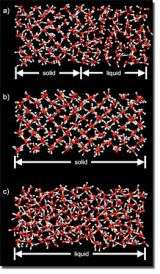
Representative snapshots of two-phase simulations of water at a pressure of 50 GPa (500,000 atmospheres of pressure). The coordinates correspond to: a) the initial starting configuration at 2000 K, b) the final configuration at 2000 K, and c) the final configuration at 2250 K.

For pressures between 100,000 and 400,000 atmospheres, the team, led by Eric Schwegler, found that ice melts as a molecular solid (similar to how ice melts in a cold drink).

But in pressures above 450,000 atmospheres, there is a sharp increase in the slope of the melting curve due to molecular disassociation and proton diffusion in the solid, prior to melting, which is typically referred to as a superionic solid phase.

“The sharp increase in the melting curves slope opens up the possibility that water exists as a solid in the deep interior of planets such as Neptune, Uranus and Earth,” Schwegler said.

Determining the melting curve of water is important to many fields of science, including physics, chemistry and planetary science.

It has been proposed that the cold subduction zones in Earth are likely to intersect with the high-pressure melting curve of water, which would have profound implications for the composition and transport of materials in the interior as well as the long-term evolution of the planet as it cools.

The new research pinpoints the melting curve at extremely high pressures (350,000 to 450,000 atmospheres of pressure), similar to those found in the interiors Neptune, Uranus and Earth.

At higher pressures, the team found that the onset of molecular dissociation and proton diffusion under pressure occurs gradually and bears many similarities to a type-II superionic solid, such as lead fluoride.

“To accurately determine the melting temperature of water, we used a two-phase simulation method that is designed to avoid the large super-heating and cooling effects that are often present in single-phase heat-until-it-melts or squeeze-until-it-freezes approaches,” Schwegler said.

The research team also includes former LLNL scientists (now at UC Davis) François Gygi and Giulia Galli and UC Davis researcher Manu Sharma.

The article appears in the Sept. 22 online edition of the Proceedings of the National Academy of Science.

Provided by Lawrence Livermore National Laboratory

Explore further: As chaos celebrates its 50th birthday, biophysicist develops a new method to visualize it

add to favorites email to friend print save as pdf

Related Stories

Mars Icebreaker Life mission

May 16, 2013

Missions to Mars have only scratched its surface. To go deeper, scientists are proposing a spacecraft that can drill into the Red Planet to potentially find signs of life.

The surprising ooze factor of glass

May 01, 2013

(Phys.org) —Reach for a tall glass of iced tea. Don't drink. Look at the glass instead. The glass is an amorphous solid, consisting of molecules jumbled in disarray. It's the complete opposite of the ice ...

Carbon's role in planetary atmosphere formation

Apr 08, 2013

(Phys.org) —A new study of how carbon is trapped and released by iron-rich volcanic magma offers clues about the early atmospheric evolution on Mars and other terrestrial bodies.

Scientists to Io: Your volcanoes are in the wrong place

Apr 04, 2013

(Phys.org) —Jupiter's moon Io is the most volcanically active world in the Solar System, with hundreds of volcanoes, some erupting lava fountains up to 250 miles high. However, concentrations of volcanic ...

Recommended for you

Physicists help design, build cargo X-ray scanners

12 hours ago

(Phys.org) —Two SLAC physicists with decades of particle accelerator experience helped a Silicon Valley company design and build X-ray devices that scan cargo containers for nuclear materials and other ...

Theorists weigh in on where to hunt dark matter

12 hours ago

(Phys.org) —Now that it looks like the hunt for the Higgs boson is over, particles of dark matter are at the top of the physics "Most Wanted" list. Dozens of experiments have been searching for them, but ...

User comments : 0

More news stories

Theorists weigh in on where to hunt dark matter

(Phys.org) —Now that it looks like the hunt for the Higgs boson is over, particles of dark matter are at the top of the physics "Most Wanted" list. Dozens of experiments have been searching for them, but ...

Hydrogen atoms under the magnifying glass

To describe the microscopic properties of matter and its interaction with the external world, quantum mechanics uses wave functions, whose structure and time dependence is governed by the Schrödinger equation. ...

Forecast for Titan: Wild weather could be ahead

(Phys.org) —Saturn's moon Titan might be in for some wild weather as it heads into its spring and summer, if two new models are correct. Scientists think that as the seasons change in Titan's northern hemisphere, ...