Girders Get the Green Light
Sep 18, 2008
Girders Get the Green Light
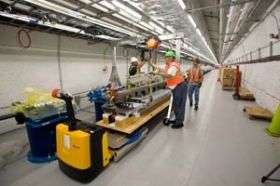
Workers position the undulator girder next to the support pedestals using an electric pallet jack. Photo by Brad Plummer.

(PhysOrg.com) -- The temperature is now stabilized at a mild 68 °F (20 °C), support pedestals are in place and aligned, the paint is dry and physicists are moving in. That's the scene in the Linac Coherent Light Source Undulator Hall, where the last items on the civil construction punch list are being checked off. Last week, after extensive monitoring and testing of the air handling system, workers began moving in crates containing the heavy, precision-aligned steel girders that will support the LCLS undulators.

"It's a pretty big milestone, getting these things in here," said Mike Zurawel, SLAC area manager for the Undulator Hall.

Girder installation marks the latest step toward completion of the LCLS construction project, which began in 2006. Situated inside a tunnel leading from SLAC's Research Yard, the 300-foot long, climate-controlled Undulator Hall will house arrays of magnets used to produce X-rays from a beam of accelerated electrons. The undulator magnets will rest atop the 33 specially designed girders now being installed.

The girder assemblies are more than sturdy mounting stands for the undulators. Designed and built by collaborators at Argonne National Laboratory, the girders also support the vacuum chamber that carries the electron and X-ray beams, as well as the adjacent quadrupole steering magnets, diagnostic equipment and a sophisticated leveling system to monitor the position of the girder assemblies.

Crates housing the six-foot, 2,600-pound girders are unwieldy to maneuver, but SLAC's Mechanical Fabrication department simplified the problem with a custom-built swivel plate and wheeled dolly system. The swivel plate couples with an electric pallet jack positioned under one end of the eight-foot crate, with the aluminum dolly placed beneath the other end. The system enables workers to move the crates through a tight maze of shielding corridors leading into the Undulator Hall. Once the crate is in position, workers use a hand-operated gantry crane to hoist the girder into place atop the support pedestals.

As next steps, another team will install and adjust the girders in preparation for undulator magnet installation, which should begin early next year.

Provided by SLAC, by Brad Plummer

Explore further: New X-ray method shows how frog embryos could help thwart disease

add to favorites email to friend print save as pdf

Related Stories

US seizes Bitcoin operator accounts

3 hours ago

US authorities seized the accounts of a Bitcoin digital currency exchange operator, claiming it was functioning as an "unlicensed money service business," court documents showed Friday.

Chinese, Indian airlines face EU pollution fines

3 hours ago

Eight Chinese and two Indian airlines face fines of up to several million euros for not paying for their greenhouse gas emissions during flights within the bloc, the European Commission said on Friday.

Alaska volcano shoots ash 15,000 feet into the air

3 hours ago

(AP)—One of Alaska's most restless volcanoes has shot an ash cloud 15,000 feet into the air in an ongoing eruption that has drawn attention from a nearby community but isn't expected to threaten air traffic.

Front-row seats to climate change

12 hours ago

By day, insects provide the white noise of the South, but the night belongs to the amphibians. In a typical year, the Southern air hangs heavy from the humidity and the sounds of wildlife.

Recommended for you

Bringing life into focus

May 17, 2013

Spinning-disk confocal microscopy is an optical imaging technique that can be used to generate detailed three-dimensional fluorescence images of living cells and their contents. Although a powerful tool for ...

World's smallest droplet

May 17, 2013

(Phys.org) —Physicists may have created the smallest drops of liquid ever made in the lab. That possibility has been raised by the results of a recent experiment conducted by Vanderbilt physicist Julia Velkovska and her ...

User comments : 0

More news stories

New principle may help explain why nature is quantum

Like small children, scientists are always asking the question 'why?'. One question they've yet to answer is why nature picked quantum physics, in all its weird glory, as a sensible way to behave. Researchers ...

Heat-related deaths in Manhattan projected to rise

Residents of Manhattan will not just sweat harder from rising temperatures in the future, says a new study; many may die. Researchers say deaths linked to warming climate may rise some 20 percent by the 2020s, ...

Kinks and curves at the nanoscale

One of the basic principles of nanotechnology is that when you make things extremely small—one nanometer is about five atoms wide, 100,000 times smaller than the diameter of a human hair—they are going ...