James Webb Telescope components pass tests
You might think that shaking and freezing a state-of-the-art, meticulously crafted machine is a bad idea. But when it comes to firing telescopes and their instruments into the frigid cold of space, the more you test your hardware, the better.
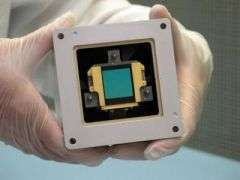
Development models for components of the Mid-Infrared Instrument on NASA's James Webb Space Telescope have now passed a series of temperature and vibration tests. Now that engineers know the models could survive the ride to space, they have begun building parts of the actual instrument.
"Our models went through some harsh abuse and survived," said Michael Ressler, the project scientist for the Mid-Infrared Instrument at NASA's Jet Propulsion Laboratory, Pasadena, Calif., where the tests were performed.
The Webb telescope will be the most sensitive infrared space telescope ever built. Its many pursuits include: seeing the farthest galaxies in the universe and the light of the first stars; studying young planetary systems; and looking for conditions suitable for life on planets around other stars.
The Mid-Infrared Instrument is the telescope's longest-wavelength instrument and will operate between so-called mid-infrared wavelengths of 5 through 28.5 microns (a micron is about 1/100 the width of a human hair). It will be the most sensitive mid-infrared detector ever flown in space.
Infrared instruments are extremely sensitive to heat, so they must be kept icy cold. A refrigerator system onboard the Webb telescope will chill the Mid-Infrared Instrument down to temperatures as low as 7 Kelvin (about 266 degrees below zero Celsius) -- significantly colder than the telescope's other instruments.
When designing the Mid-Infrared Instrument, engineers have to take this cold temperature into account. The instrument will have three detectors housed in insulated, brick-like structures called focal plane modules. The detectors have to be perfectly aligned within these brick structures, so that when the chill shrinks the various materials, they do not become misaligned.
"Different materials shrink by varying amounts when cooled. The materials we are using in the focal plane modules can shrink as much as 200 microns. Our instrument alignment needs to be within 50 microns, so it's crucial that our instrument design accounts for the varying thermal contractions at cold temperatures," said Kalyani Sukhatme, the project element manager for the focal plane modules at JPL.
In addition to temperature threats, the focal plane modules will undergo extreme rattles and shakes during launch -- further opportunities to become misaligned.
Because models for these focal plane modules have now officially passed temperature and vibration tests, one of the actual, or "flight," modules has been built and is currently going through its testing.
Source: NASA's Goddard Space Flight Center


