Coating copies microscopic biological surfaces
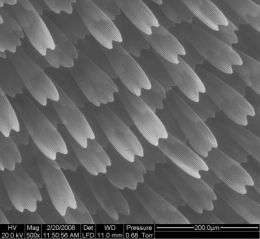
Someday, your car might have the metallic finish of some insects or the deep black of a butterfly's wing, and the reflectors might be patterned on the nanostructure of a fly's eyes, according to Penn State researchers who have developed a method to rapidly and inexpensively copy biological surface structures.
"Only a small fraction of mutations in evolutionary processes are successful," says Akhlesh Lakhtakia, the Charles Godfrey Binder (Endowed) Professor of Engineering Science and Mechanics. "But, evolution has gone on for at least a billion years. A huge range of biological surface architectures have been created and are available."
Lakhtakia and his colleagues, Carlo G. Pantano, distinguished professor of materials science and engineering, and director of Penn State's Materials Research Institute, and Raúl J. Martín-Palma, visiting professor, Penn State, and professor department of applied physics, Universidad Autónomia de Madrid, used the conformal evaporated film by rotation (CEFR) technique, to produce coatings that capture the micro and nano structure of biological surfaces in a thin coating of glass. The results appear in recent issues of Applied Physics Letters and Nanotechnology.
In the CEFR technique, the researchers thermally evaporate the material that forms the coating in a vacuum chamber. The object receiving the coating is fixed to a holder and rotated about once every two seconds. The researchers have coated butterfly wings and a fly, creating replicas of these templates with identical surface characteristics. The researchers are using chalcogenide glasses composed of varying combinations of germanium, antimony and selenium.
"With the right temperature, which is room temperature, and the right pressure and rotation speed, the coating process takes about 10 minutes and deposits a 500- nanometer layer," says Lakhtakia.
Some biostructures, such as moth's eyes, which are duplicated to produce moth's-eye lenses, can be mechanically created by engineers, but it is painstaking and expensive work. These lenses, that capture nearly all available light, have applications in optoelectronic and photovoltaic applications. Other biostructures do not lend themselves to synthetic reproduction.
"In that case, perhaps we need to replicate the actual structure," says Lakhtakia. "One insect has an iridescent shell that does not change colors as many shiny ones do. No one has made this type of material artificially because we do not know the mechanism by which it retains its color, but making a template from the actual insect would replicate the fine structure of the surface."
Many things in the natural world are colored not by pigment, but by surface structure. The way light interacts with the surface creates the color, rather than any tint or chemical. Reproducing the surface reproduces the color. Surface properties include not just visible light characteristics, but also infra red, thermal, stickiness and other characteristics.
Martín-Palma, Pantano and Lakhtakia's work creates either a replica template or a mold depending on what they coat. The replica of a template can be used to create a mold in a harder, less damageable material to make many copies. Molds can be combined and multiplied to create the desired surfaces.
The researchers initially looked at surfaces with optical properties because they are easy to see and identify. The structural black of some butterflies invites investigation of thermal properties as well. Creating surfaces that have micro or nanoscale patterns on solar cells, heat exchangers, reflectors and lenses can produce devices that work more efficiently.
"The whole world of biomimetics and bioinspiration is just beginning to emerge," says Martín-Palma. "Butterfly wings come in a large variety of surface structures. Eventually we may be able to take these biological structures and modify them to create other properties that do not already exist on biological surfaces."
While the researchers are still experimenting with butterfly wings, they would like to use CEFR on lotus leaves because they are super hydrophobic. Surfaces that repel water could be very useful. They also plan to look at other plant materials as potential surfaces for solar cells. Lakhtakia and Martín-Palma are organizing a small conference next year on biomimetics and bionispiration.
Pantano suggested the use of chalcogenide glass for its infrared properties, but the researchers have also tried other glasses and materials like polymers to reproduce other surfaces and their properties.
Source: Penn State


