A 'Genetic Study' of the Galaxy
Sep 11, 2008
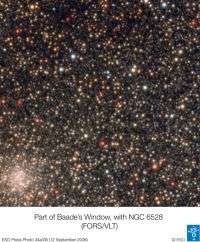
The Field around Baade's Window (FORS/VLT) Part of one of the four regions of the sky in the direction of the Galactic Bulge in which the astronomers measured the iron and oxygen abundances in stars. This particular field is in the vicinity of the so-called 'Baade's Window', a region with relatively low amounts of interstellar "dust" that could block the sight, allowing astronomers to peer into the central parts of the Milky Way galactic centre and beyond. The globular cluster NGC 6528 is visible in the lower left corner. The image is a colour composite, based on images obtained in the B-, V-, and I-filters with the FORS instrument on the ESO VLT. The images were extracted from the ESO Science Archive and processed by Henri Boffin (ESO). North is to the right and East on top.

(PhysOrg.com) -- Looking in detail at the composition of stars with ESO's VLT, astronomers are providing a fresh look at the history of our home galaxy, the Milky Way. They reveal that the central part of our Galaxy formed not only very quickly but also independently of the rest.

"For the first time, we have clearly established a 'genetic difference' between stars in the disc and the bulge of our Galaxy," said Manuela Zoccali, lead author of the paper presenting the results in the journal Astronomy and Astrophysics. "We infer from this that the bulge must have formed more rapidly than the disc, probably in less than a billion years and when the Universe was still very young."

The Milky Way is a spiral galaxy, having pinwheel-shaped arms of gas, dust, and stars lying in a flattened disc, and extending directly out from a spherical nucleus of stars in the central region. The spherical nucleus is called a bulge, because it bulges out from the disc. While the disc of our Galaxy is made up of stars of all ages, the bulge contains old stars dating from the time the galaxy formed, more than 10 billion years ago. Thus, studying the bulge allows astronomers to know more about how our Galaxy formed.
To do this, an international team of astronomers analysed in detail the chemical composition of 50 giant stars in four different areas of the sky towards the Galactic bulge. They made use of the FLAMES/UVES spectrograph on ESO's Very Large Telescope to obtain high-resolution spectra.

The chemical composition of stars carries the signature of the enrichment processes undergone by the interstellar matter up to the moment of their formation. It depends on the previous history of star formation and can thus be used to infer whether there is a 'genetic link' between different stellar groups. In particular, comparison between the abundance of oxygen and iron in stars is very illustrative. Oxygen is predominantly produced in the explosion of massive, short-lived stars (so-called Type II supernovae), while iron instead originates mostly in Type Ia supernovae, which can take much longer to develop. Comparing oxygen with iron abundances therefore gives insight on the star birth rate in the Milky Way's past.

"The larger size and iron-content coverage of our sample allows us to draw much more robust conclusions than were possible until now," said Aurelie Lecureur, from the Paris-Meudon Observatory (France) and co-author of the paper.

The astronomers clearly established that, for a given iron content, stars in the bulge possess more oxygen than their disc counterparts. This highlights a systematic, hereditary difference between bulge and disc stars.

"In other words, bulge stars did not originate in the disc and then migrate inward to build up the bulge but rather formed independently of the disc," said Zoccali. "Moreover, the chemical enrichment of the bulge, and hence its formation timescale, has been faster than that of the disc."

Comparisons with theoretical models indicate that the Galactic bulge must have formed in less than a billion years, most likely through a series of starbursts when the Universe was still very young.

Article: www.edpsciences.org/articles/aa/pdf/2006/37/aa5659-06.pdf

Provided by ESO

Explore further: NASA builds unusual testbed for analyzing X-ray navigation technologies

add to favorites email to friend print save as pdf

Related Stories

Hubble sees an actively star-forming galaxy, NGC 7090

Sep 17, 2012

(Phys.org)—This image portrays a beautiful view of the galaxy NGC 7090, as seen by the NASA/ESA Hubble Space Telescope. The galaxy is viewed edge-on from the Earth, meaning we cannot easily see the spiral ...

Hubble sees a spiral within a spiral

May 28, 2012

(Phys.org) -- NASA's Hubble Space Telescope captured this image of the spiral galaxy known as ESO 498-G5. One interesting feature of this galaxy is that its spiral arms wind all the way into the center, so ...

A spiral galaxy in Hydra

Apr 09, 2012

(Phys.org) -- This image from the NASA/ESA Hubble Space Telescope shows NGC 4980, a spiral galaxy in the southern constellation of Hydra. The shape of NGC 4980 appears slightly deformed, something which is ...

A galactic rose highlights Hubble's 21st anniversary

Apr 20, 2011

(PhysOrg.com) -- In celebration of the 21st anniversary of the Hubble Space Telescope’s deployment into space, astronomers pointed Hubble at an especially photogenic group of interacting galaxies called ...

Recommended for you

Fragile mega-galaxy is missing link in history of cosmos

4 hours ago

Two hungry young galaxies that collided 11 billion years ago are rapidly forming a massive galaxy about 10 times the size of the Milky Way, according to UC Irvine-led research published Wednesday in the journal ...

Galaxy's Ring of Fire

May 18, 2013

Johnny Cash may have preferred this galaxy's burning ring of fire to the one he sang about falling into in his popular song. The "starburst ring" seen at center in red and yellow hues is not the product of ...

User comments : 0

More news stories

Forecast for Titan: Wild weather could be ahead

(Phys.org) —Saturn's moon Titan might be in for some wild weather as it heads into its spring and summer, if two new models are correct. Scientists think that as the seasons change in Titan's northern hemisphere, ...

SDO observes mid-level solar flare

UPDATE 16:30 p.m. EDT: The M7-class flare was also associated with a coronal mass ejection or CME, another solar phenomenon that can send billions of tons of particles into space. While this CME was not Ea ...

NASA's Landsat satellite looks for a cloud-free view

For decades, Landsat satellites have documented the desiccation of the Aral Sea in Central Asia. Once one of the largest seas in the world, it shrunk to a tenth of its original volume after Russia diverted ...

New cave-dwelling arachnids discovered in Brazil

Two new species of cave-dwelling short-tailed whipscorpions have been discovered in northeastern Brazil, and are described in research published May 22 in the open access journal PLOS ONE by Adalberto Santos ...