Research team proposes new link to tropical African climate
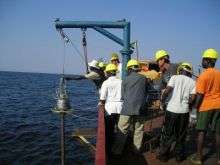
The Lake Tanganyika area, in southeast Africa, is home to nearly 130 million people living in four countries that bound the lake, the second deepest on Earth. Scientists have known that the region experiences dramatic wet and dry spells, and that rainfall profoundly affects the area's people, who depend on it for agriculture, drinking water and hydroelectric power.
Scientists thought they knew what caused those rains: a season-following belt of clouds along the equator known as the Intertropical Convergence Zone (ITCZ). Specifically, they believed the ITCZ and rainfall and temperature patterns in the Lake Tanganyika area marched more or less in lockstep. When the ITCZ moved north of the equator during the northern summer, the heat (and moisture) would follow, depriving southeast Africa of moisture and rainfall. When the ITCZ moved south of the equator during the northern winter, the moisture followed, and southeast Africa got rain.
Now a Brown-led research team has discovered the ITCZ may not be the key to southeast Africa's climate after all. Examining data from core sediments taken from Lake Tanganyika covering the last 60,000 years, the researchers report in this week's Science Express that the region's climate instead appears to be linked with ocean and atmospheric patterns in the Northern Hemisphere. The finding underscores the interconnectedness of the Earth's climate — how weather in one part of the planet can affect local conditions half a world away.
The discovery also could help scientists understand how tropical Africa will respond to global warming, said Jessica Tierney, a graduate student in Brown's Geological Sciences Department and the paper's lead author.
"It just implies the sensitivity of rainfall in eastern Africa is really high," Tierney said. "It doesn't really take much to tip it."
The researchers, including James Russell and Yongsong Huang of Brown's Department of Geological Sciences faculty and scientists at the University of Arizona and the Royal Netherlands Institute for Sea Research, identified several time periods in which rainfall and temperature in southeast Africa did not correspond with the ITCZ's location. One such period was the early Holocene, extending roughly from 11,000 years ago to 6,000 years ago, in which the ITCZ's location north of the equator would have meant that tropical Africa would have been relatively dry. Instead, the team's core samples showed the region had been wet.
Two other notable periods — about 34,000 years ago and about 58,000 years ago — showed similar discrepancies, the scientists reported.
In addition, the team found climatic changes that occurred during stadials (cold snaps that occur during glacial periods), such as during the Younger Dryas, suddenly swung rainfall patterns in southeast Africa. Some of those swings occurred in less than 300 years, the team reported.
"That's really fast," Tierney noted, adding it shows precipitation in the region is "jumpy" and could react abruptly to changes wrought by global warming.
While the scientists concluded the ITCZ is not the dominant player in shaping tropical African climate, they say more research is needed to determine what drives rainfall and temperature patterns there. They suspect that a combination of winter winds in northern Asia and sea surface temperatures in the Indian Ocean have something to do with it. Under this scenario, the winds emanating from Asia would pick up moisture from the Indian Ocean as they swept southward toward tropical Africa. The warmer the waters the winds passed over, the more moisture would be gathered, and thus, more rain would fall in southeast Africa. The theory would help explain the dry conditions in southeast Africa during the stadials, Tierney and Russell said, because Indian Ocean surface temperatures would be cooler, and less moisture would be picked up by the prevailing winds.
"What happens in southeast Africa appears to be really sensitive to the Indian Ocean's climate," Russell said.
The team examined past temperature in the region using a proxy called TEX86, developed by the Dutch contributing authors. To measure past precipitation, the researchers examined fatty acid compounds contained in plant leaf waxes stored in lakebed sediments — a relatively new proxy but considered by scientists to be a reliable gauge of charting past rainfall.
Source: Brown University


