NASA to Explore 'Secret Layer' of the Sun
Next April, for a grand total of 8 minutes, NASA astronomers are going to glimpse a secret layer of the sun.
Researchers call it "the transition region." It is a place in the sun's atmosphere, about 5000 km above the stellar surface, where magnetic fields overwhelm the pressure of matter and seize control of the sun's gases. It's where solar flares explode, where coronal mass ejections begin their journey to Earth, where the solar wind is mysteriously accelerated to a million mph.
It is, in short, the birthplace of space weather.
Researchers hope it is about to yield its secrets.
"Early next year, we're going to launch an experimental telescope that can measure vector magnetic fields in the transition region," explains Jonathan Cirtain of the Marshall Space Flight Center (MSFC). Previous studies have measured these fields above and below the transition region—but never inside it. "We hope to be the first."
The name of the telescope is SUMI, short for Solar Ultraviolet Magnetograph Investigation. It was developed by astronomers and engineers at the MSFC and is currently scheduled for launch from White Sands, New Mexico, in April 2009.
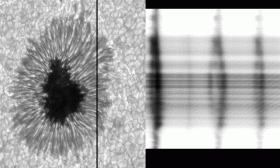
SUMI works by means of "Zeeman splitting." Dutch physicist Pieter Zeeman discovered the effect in the 19th century. When a glass tube filled with incandescent gas is dipped into a magnetic field, spectral lines emitted by the gas get split into two slightly different colors—the stronger the field, the bigger the splitting. The same thing happens on the sun. Here, for instance, are some spectral lines from gaseous iron being split by the magnetic field of a sunspot (see image above).
By measuring the gap, astronomers estimate the strength of the sunspot's magnetic field. Furthermore, by measuring the polarization of the split line, astronomers can figure out the direction of the magnetic field. Strength + direction = everything you ever wanted to know about a magnetic field!
This trick has been applied to thousands of sunspots on the solar surface, but never to the transition region just a short distance above.
Why not?
"Just bad luck, really," says Cirtain. "Gas in the transition region doesn't produce many strong spectral lines that we can see at visible wavelengths." It does, however, produce lines at UV wavelengths invisible from Earth's surface.
"That's why we have to leave Earth."
SUMI will blast off inside the nose cone of a Black Brant rocket on a sub-orbital flight that takes it to an altitude of 300 km. "We'll be above more than 99.99% of Earth's atmosphere," says Cirtain. About 68 seconds into the flight, payload doors will open, affording SUMI a crystal-clear view of the UV sun. "From that moment, we've only got 8 minutes to work with. We'll target an active region and start taking data."
SUMI's "vector magnetograph" is tuned to study a pair of spectral lines: one from triply-ionized carbon (CIV) at 155 nanometers and a second from singly-ionized magnesium (MgII) at 280 nanometers. "There's nothing special about those ions," notes Cirtain. "They just happen to produce the best and brightest lines at temperatures and densities typical of the transition region."
Cirtain anticipates how it will feel to have his precious instrument hurtling 300 km above Earth at 5,000 mph: "Eight minutes of terror." He'll start breathing again when the payload doors close and SUMI begins its descent back to Earth. Cirtain ticks off the stages: "Reentry into the atmosphere. Open parachutes. Landing back at White Sands. Recovery."
The short flight probably won't lead to immediate breakthroughs. "But it will demonstrate the SUMI concept and show us if it's going to work." A successful flight would lead to more flights and eventually to a SUMI-style magnetograph permanently installed on a space telescope.
"That's the dream," he says. Transition region, prepare to yield...
Source: Science@NASA, by Dr. Tony Phillips


