Hurricane Hanna Not Moving Much Near North of the Caicos Islands
Sep 01, 2008
Credit: NASA/JPL

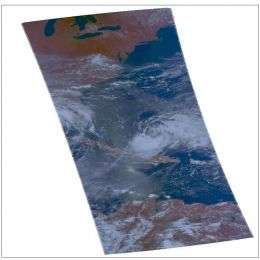
Tropical Storm Hanna has virtually parked herself north of the Caicos Islands in the Atlantic Ocean, continuing to bring residents heavy rains and winds. A tropical storm warning remains in effect for the central and southeastern Bahamas and the Turks and Caicos islands.

This visible image of Hanna was created by data from the Atmospheric Infrared Sounder (AIRS), an instrument that flies aboard NASA's Aqua satellite. It was created on August 31 at 18:11 UTC (2:11 p.m. EDT).

At 8:00 a.m. EDT the center of Tropical Storm Hanna had maximum sustained winds near 50 mph. She was located near latitude 23.6 north and longitude 72.4 west or about 90 miles north-northeast of the southeastern Bahamas. She's been nearly stationary, drifting westward near 2 mph and will continue that way for the next day or two. On the forecast track the center of Hanna will move near or over the southeastern Bahamas during the next day or two. The estimated minimum central pressure is 996 millibars.

Rainfall expected through Thursday over the central and Southeastern Bahamas and the Turks and Caicos islands will be between 4 to 8 inches with maximum amounts near 12 inches. In addition, ocean swells are expected to increase the risk of dangerous rip currents along portions of the southeastern United States coast during the next couple of days.

Source: by Rob Gutro/Goddard Space Flight Center

Explore further: Astonishing hi-resolution satellite views of the destruction from the Moore, Oklahoma tornado

add to favorites email to friend print save as pdf

Related Stories

Forecast for Titan: Wild weather could be ahead

43 minutes ago

(Phys.org) —Saturn's moon Titan might be in for some wild weather as it heads into its spring and summer, if two new models are correct. Scientists think that as the seasons change in Titan's northern hemisphere, ...

NASA's Landsat satellite looks for a cloud-free view

57 minutes ago

For decades, Landsat satellites have documented the desiccation of the Aral Sea in Central Asia. Once one of the largest seas in the world, it shrunk to a tenth of its original volume after Russia diverted ...

Recommended for you

Strong earthquake at exceptional depth

May 24, 2013

This morning at 05:45 CEST, the earth trembled beneath the Okhotsk Sea in the Pacific Northwest. The quake, with a magnitude of 8.2, took place at an exceptional depth of 605 kilometers. Because of the great ...

Marine forecasting on the horizon for Indian Ocean Rim

May 24, 2013

Nearly all of the member countries of the Indian Ocean Rim Association for Regional Cooperation (IOR-ARC) will attend the week-long workshop to further cooperation and understanding on international ocean ...

Russia evacuates drifting Arctic research station

May 23, 2013

Russia has ordered the urgent evacuation of the 16-strong crew of a drifting Arctic research station after ice floe that hosts the floating laboratory began to disintegrate, officials said Thursday.

User comments : 0

More news stories

Galaxies fed by funnels of fuel

(Phys.org) —Computer simulations of galaxies growing over billions of years have revealed a likely scenario for how they feed: a cosmic version of swirly straws.