How Do Galaxies Grow?
Aug 26, 2008
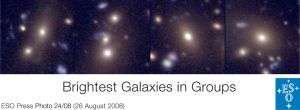
Composite colour-image of the brightest galaxies in four groups located about 4 billion light-years away. The galaxies are ordered in increasing stellar mass, i.e. a rough time sequence. The brightest galaxies in group 1 and 2 both have obvious bright, gravitationally bound companions. The inset in this image obtained with the Hubble Space Telescope shows that the brightest galaxy in group 3 has also a double nucleus. Thus, these galaxies are currently in the process of merging. This discovery provides unique and powerful validation of hierarchical formation as manifested in both galaxy and cluster assembly.

How do galaxies form? The most widely accepted answer to this fundamental question is the model of 'hierarchical formation', a step-wise process in which small galaxies merge to build larger ones. One can think of the galaxies forming in a similar way to how streams merge to form rivers, and how these rivers, in turn, merge to form an even larger river. This theoretical model predicts that massive galaxies grow through many merging events in their lifetime. But when did their cosmological growth spurts finish? When did the most massive galaxies get most of their mass?

To answer these questions, astronomers study massive galaxies in clusters, the cosmological equivalent of cities filled with galaxies. "Whether the brightest galaxies in clusters grew substantially in the last few billion years is intensely debated. Our observations show that in this time, these galaxies have increased their mass by 50%," says Kim-Vy Tran from the University of Zürich, Switzerland, who led the research.

The astronomers made use of a large ensemble of telescopes and instruments, including ESO's Very Large Telescope (VLT) and the Hubble Space Telescope, to study in great detail galaxies located 4 billion light-years away. These galaxies lie in an extraordinary system made of four galaxy groups that will assemble into a cluster.

In particular, the team took images with VIMOS and spectra with FORS2, both instruments on the VLT. From these and other observations, the astronomers could identify a total of 198 galaxies belonging to these four groups.

The brightest galaxies in each group contain between 100 and 1000 billion of stars, a property that makes them comparable to the most massive galaxies belonging to clusters.

"Most surprising is that in three of the four groups, the brightest galaxy also has a bright companion galaxy. These galaxy pairs are merging systems," says Tran.

The brightest galaxy in each group can be ordered in a time sequence that shows how luminous galaxies continue to grow by merging until recently, that is, in the last 5 billion years. It appears that due to the most recent episode of this 'galactic cannibalism', the brightest galaxies became at least 50% more massive.

This discovery provides unique and powerful validation of hierarchical formation as manifested in both galaxy and cluster assembly.

"The stars in these galaxies are already old and so we must conclude that the recent merging did not produce a new generation of stars," concludes Tran. "Most of the stars in these galaxies were born at least 7 billion years ago."

Source: ESO

Explore further: NASA builds unusual testbed for analyzing X-ray navigation technologies

add to favorites email to friend print save as pdf

Related Stories

Light echoes from V838 Mon

Mar 19, 2013

(Phys.org) —What caused this outburst of V838 Mon? For reasons unknown, star V838 Mon's outer surface suddenly greatly expanded with the result that it became the brightest star in the entire Milky Way ...

Astronomers amazed at timing of Markarian 421 'blazer'

Apr 18, 2013

(Phys.org) —The field of view from Earth is being flooded with the brightest display of gamma rays ever seen, the BBC is reporting, at a time when space researchers around the world have just coincidently trained ...

Most distant blazar is a high-energy astrophysics puzzle

Apr 18, 2013

(Phys.org) —Blazars are the brightest of active galactic nuclei, and many emit very high-energy gamma rays. New observations of the blazar known as PKS 1424+240 show that it is the most distant known source ...

Recommended for you

Fragile mega-galaxy is missing link in history of cosmos

1 hour ago

Two hungry young galaxies that collided 11 billion years ago are rapidly forming a massive galaxy about 10 times the size of the Milky Way, according to UC Irvine-led research published Wednesday in the journal ...

Galaxy's Ring of Fire

May 18, 2013

Johnny Cash may have preferred this galaxy's burning ring of fire to the one he sang about falling into in his popular song. The "starburst ring" seen at center in red and yellow hues is not the product of ...

User comments : 2

Adjust slider to filter visible comments by rank

Display comments: newest first

yyz
4 / 5 (1) Aug 26, 2008
There are a few galaxy clusters near us that have potentially interacting-merging galaxies near their cores (The Local Group, Coma Cluster, Fornax Cluster, Perseus Cluster, to name a few). But it does appear that most major galaxy mergers in clusters took place in the distant past. Perhaps in our recent epoch, most of these major-mergers in clusters (which spawned cD galaxies & Brightest Cluster Galaxies) have already taken place and only smaller galaxies & dwarf galaxies remain to be cannabalized (Think M 87 in the Virgo Cluster). This scenario seems to make sense considering 4 billion years ago, more massive galaxy clusters were just taking shape & several large galaxies near the cluster center were in the process of merging. This may also explain why active quasars are more abundant in the distant (& early) universe than is seen nearby today.
smiffy
4 / 5 (1) Aug 27, 2008
If the theory is correct and galaxies do merge regularly does anyone know of the possible effects the mergers would have on planetary systems in the galaxies concerned?

It seems to me that our solar system with its planets in circular orbit hasn't had a close encounter with a passing star which would (I'm guessing) cause the orbits to become elliptical.

Has anyone done a simulation or the maths to determine what kind of probability this kind of disturbance has?

More news stories

Facebook joins Web freedom group

Facebook on Wednesday became a full member of the Global Network Initiative, a non-governmental organization promoting Internet freedom and privacy rights.