Living with a Star
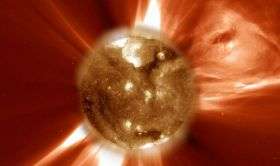
What if you woke up one morning and found your whole planet had been swallowed by the atmosphere of a star?
Get out of bed, look out the window. Auroras are dancing along the horizon. Dark sunspots crackle overhead—each little 'pop' more powerful than a nuclear bomb. On TV, a weather forecaster warns astronauts, "a solar flare is sure to erupt," although he can't say exactly when. Moments later, the satellite signal begins to flicker.
Where is this place?
Welcome to planet Earth.
"It's true. We live inside the atmosphere of the sun," says Lika Guhathakurta, program manager of NASA's Living with a Star (LWS) program.
At first glance the sun seems so self-contained, a crisp round ball in the noontime sky. But the edge we see is just the beginning. The sun has a hot, riotous atmosphere called "the corona" that reaches from the sun's surface, past Earth, all the way to Pluto and beyond. The corona is seldom seen, only during a total eclipse, but it is there.
Like any good atmosphere, the corona has weather, and lots of it. There are billion-ton coronal mass ejections; high-energy radiation storms; and a relentlessly-blowing solar wind that gusts up to a million mph. Every comet, asteroid and planet in the solar system is exposed to these elements.
Our planet is better protected than most. We have a thick atmosphere and global magnetic field to hold space weather at bay. In fact, if we stayed on Earth, the sun's weather systems would hardly affect us, causing no more than an occasional power outage or radio blackout.
And therein lies the problem:
"We're not staying on Earth," says Guhathakurta. "Civilization is spreading into space."
More than 500 active satellites circle the Earth. We rely on them for TV, telephone, internet, GPS navigation and weather forecasting; all are vulnerable to space weather. Humans orbit Earth, too, onboard the International Space Station. The ISS is located inside Earth's magnetic field, so it enjoys a degree of protection, but future astronauts en route to the Moon and Mars will be outside the magnetic bubble. Their spaceships are going to be in direct contact with the sun's atmosphere.
NASA's Living With a Star Program was formed in 2001 to deal with this reality. "If we're going to live inside the sun's atmosphere, we need to learn more about it—especially how to predict the storms," says Guhathakurta.
The basic strategy is the same as weather studies on Earth: "We're going to launch a fleet of 'weather stations' – spacecraft that observe different aspects of sun’s atmosphere." LWS has five missions1 in various states of development. Together they will surround and explore the sun in ways no spacecraft has done before.
#1: The Solar Dynamics Observatory (SDO). "Get ready for jaw-dropping photos," says Guhathakurta. A camera onboard the observatory will take HDTV quality photographs of sunspots and solar flares, revealing the onset of storms in never-before-seen detail.
Pictures alone, however, do not tell the whole story. NASA solar physicist Alex Pevtsov explains: "Solar activity is a bit like a puppet show. If you want to understand the motion of the puppets, you need to see the strings. On the sun, the 'invisible strings' are magnetic fields; they penetrate the sun's atmosphere, guiding the flow of heat and orchestrating mighty explosions. SDO will be able to produce detailed maps of magnetism on the sun, revealing the strings for all to see."
But who (or what) is pulling the strings? "That would be the sun's magnetic dynamo," says Pevtsov. "It lies hidden beneath the surface of the sun." Fortunately, SDO can look down there, too. The technique is called helioseismic imaging. By monitoring the sun's vibrating surface, SDO can probe the stellar interior in much the same way that geologists use seismic waves from earthquakes to probe inside Earth. In this way, mission scientists hope to map the ebb and flow of the sun's inner magnetic dynamo, the root of all solar activity.
Status: SDO is built and almost ready to go. "Right now, SDO is in a thermal vacuum chamber getting tested for the rough ride to space."
#2: Solar Probe Plus "This could be the most exciting mission of all." It is a heat-resistant spacecraft designed to plunge deep into the sun’s atmosphere where it can sample solar wind and magnetic fields in situ. "No spacecraft has ever been as close to the sun as Solar Probe Plus will go, only 7 million km from the surface. That's unexplored territory, and we expect to learn a great deal about the sun's atmosphere by going there."
Status: Solar Probe Plus is still in an early design phase, called "pre-phase A" at NASA Headquarters. It is expected to launch no earlier than 2015.
#3 Solar Sentinels. "We're going to surround the sun," says Guhathakurta. Three well-instrumented probes from NASA and a fourth (the Solar Orbiter) from the European Space Agency will station themselves around the sun's equator, providing the first truly global view of solar activity. "Imagine trying to figure out Earth's climate by watching only one side of the planet. Impossible! Yet that's what we've been doing with the sun." The one-sided view from Earth limits studies of solar climate and weather—a problem Solar Sentinels will remedy.
Status: "We've just finished the Science and Technology Definition Team report, which lays out the whole strategy for Solar Sentinels." Launch is expected no earlier than 2015.
#4 The Radiation Belt Storm Probes. "There's no point in studying the sun if you don't understand what it does to Earth," declares Guhathakurta. This mission makes the crucial Sun-Earth connection. Wisps of the sun's atmosphere can become trapped by Earth's magnetic field, inside radiation belts, where energetic particles lie in wait for astronauts and satellites trying to leave or simply orbit the planet. The Radiation Belt Storm Probes (two of them) will explore these regions and discover how they are populated and energized by space weather.
Status: The two probes are under construction at the Johns Hopkins Applied Physics Lab and slated for launch no earlier than 2011.
#5 The Ionosphere-Thermosphere Storm Probes. Two more probes will orbit Earth and study the upper reaches of Earth’s atmosphere where air makes "first contact" with solar UV radiation. This is a realm of electrically charged particles that strongly affect the propagation of radio waves, influencing almost all forms of telecommunication and GPS navigation. It is also a place where the atmosphere breathes in and out in response to changes in solar UV heating. An outward breath can envelop and drag down satellites, while an inward breath decreases the drag. The Ionosphere-Thermosphere Storm Probes will monitor the response of this layer to all kinds of solar storms.
Status: "This is an important mission, but not yet funded," says Guhathakurta. "Right now we have our hands full with the others."
Indeed, there's a lot to do when you're Living with a Star.
Provided by Science@NASA, by Dr. Tony Phillips


