Preparation begins for new European space mission to Mars
(PhysOrg.com) -- Scientists searching for life on Mars are now preparing for the most in-depth probe of the Red Planet ever undertaken.
The European Space Agency’s ExoMars mission will search for evidence that life may exist, investigate the Martian upper atmosphere, and analyse the physical characteristics and properties of the planet’s surface and interior.
With a scheduled launch date of 2013, scientists are already developing and testing the instruments and technologies that will be vital to the mission’s success.
Among them are Imperial researchers Professor Mark Sephton, Department of Earth Science and Engineering, Dr Tom Pike, Department of Electrical and Electronic Engineering, and Professor Steve Schwartz, from the Department of Physics.
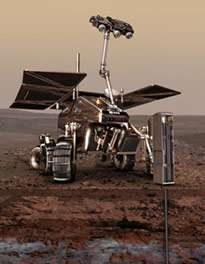
Professor Mark Sephton is part of the team that will be operating and carrying out experiments using the vehicle, called the Pasteur Rover, which is a six wheeled mobile laboratory that can travel up to several kilometres. This mobile laboratory will be remotely manoeuvred by the team to search for the organic molecules which may indicate life.
To find these molecules, the Pasteur Rover will be equipped with a range of instruments including a camera to visually navigate across the rocky terrain, a drill that can dig up to two metres below the surface, and a laboratory that will be able to analyse soil samples excavated by the drill.
In particular, the team hopes to find amino acids, which are a group of molecules that are the basic building blocks for all known life.
Professor Sephton is also experimenting with a replica of an instrument that will be used by the Pasteur Rover’s laboratory to search for life - the Sub Critical Water Extractor.
The Sub Critical Water Extractor uses hot water to extract organic molecules from soil samples excavated by the Rover’s drill. The water is turned into gas, which carries any residue molecules to condense on a cold finger, a device that collects the gas. When lasers are shone onto the cold finger any amino acids present fluoresce and can be seen by scientists.
Professor Sephton is currently experimenting with the types of temperatures needed to heat the water sufficiently to extract molecules and is also creating a catalogue of the types of minerals and organic compounds expected to be found on Mars, for use as a guide during the mission. He comments:
“The detection of life on another planet would represent the most dramatic discovery in the history of science. ExoMars and its organic detection instruments will tell us whether we are alone in the universe.”
Another important aim of the mission is to determine the strength and orientation of any Martian magnetic field. The Earth’s magnetic field is responsible for protecting it from the solar wind, which is a stream of charged particles that are ejected from the Sun’s upper atmosphere. If a planet is unprotected by a magnetic field then solar radiation can penetrate the atmosphere and destroy conditions favourable to life.
Professor Schwartz will be part of the ExoMars team that will determine whether any Martian magnetic field exists or if one was switched off billions of years ago by some geological process. He will also carry out experiments to detect magnetic disturbances driven by the solar wind in Mars’ upper atmosphere. These magnetic disturbances act similarly to sonar and seismological waves and penetrate deep underground. The team will use their instrumentation to detect how different rock layers absorb and reflect these magnetic disturbances to determine Mars’ geology. Professor Schwartz comments:
“Planetary magnetic fields like Earth’s protect the atmosphere from solar wind bombardment, helping to retain water vapour and protecting all living creatures from hazardous radiation. Without it, life would not exist on Earth. Understanding how magnetic fields exist on other planets helps us to understand how life can form and survive.”
Dr Pike is part of the ExoMars geophysics team that will be investigating the interior of Mars. He is constructing a miniature seismometer to listen for any Marsquakes – Martian earthquakes.
The microseismometer consists of springs fabricated from silicon, making it extremely sensitive to very small vibrations from Marsquakes on the other side of the planet. This device should also give information about the structure of Mars deep underground and offer clues as to how Mars has evolved since its formation.
Dr Pike is currently taking part in NASA’s Phoenix Mission which is searching for conditions which are favourable for past or present life on Mars. Speaking about the ExoMars mission he says:
"As well as investigating the potential for life, ExoMars will be the first lander to look deep within the planet. The mission I'm currently working on, Phoenix, has literally just scraped the surface of Mars. We hope with the Imperial microseismometer on ExoMars will be able to look much deeper, right down to the core of the planet."
ExoMars is scheduled to launch on November 2013, touching down on Mars in September 2014. Initially the spacecraft will be parked in orbit, allowing the time of descent to be chosen by mission scientists. This will enable the ExoMars planners to avoid the global dust storm season on Mars.
Following the landing, the Pasteur Rover will be deployed to search for traces of life. It will have a nominal lifetime of 180 sols – Martian days equalling six Earth months.
Provided by Imperial College London


