Argonne scientists discover new class of glassy material
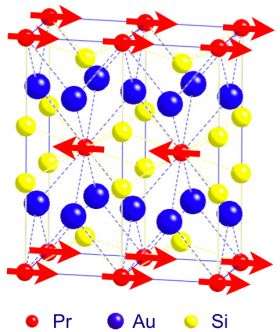
(PhysOrg.com) -- Scientists at U.S. Department of Energy's Argonne National Laboratory are dealing with an entirely new type of frustration, but it's not stressing them out.
Dynamic frustration has been found to be the cause of glassy behavior in materials that previously had none of the features of a normal glass.
"This has been a puzzle for 10 years now," Argonne physicist Raymond Osborn said.
Conventional wisdom states that glassy materials, such as common window glass, result when frustration prevents the atoms from forming a well-ordered crystal structure, and the material freezes into a disordered state like a frozen liquid.
In spin glasses, it is the magnetic moments on each atom, rather than the atoms themselves, that freeze into a disordered state at low temperatures, so that they point in random directions. However, there has to be some disorder in the atomic structure and some frustration in the magnetic interactions which prevents the magnetic moments from ordering so that they can freeze into spin glasses.
Scientists have struggled for more than a decade to understand why PrAu2Si2 is a spin glass. There is no sign of atomic disorder in the compound and, no reason for the magnetic interactions to be frustrated.
Using the results of neutron scattering experiments, Osborn and his collaborators concluded the frustration results from temporal or dynamic frustration rather static frustration.
Although PrAu2Si2 seems to have an ordered structure, by delving deeper, Osborn found that the magnetic moments are continually fluctuating in magnitude causing the equivalent of temporal potholes that appear and then disappear long enough to disrupt the magnetic alignment.
These fluctuations occur because the magnetic moments in this material are unstable and can be destroyed temporarily by electrons scattering off the atoms.
"The discovery of dynamic frustration reveals a whole new class of glassy materials whose behavior is governed by dynamic rather than static disorder," Osborn said.
This discovery may allow scientists to tune the degree of frustration and therefore develop a better understanding of how glasses are formed in nature.
A paper on Osborn's work can be seen in the upcoming edition of Nature Physics.
Source: Argonne National Laboratory


