Phoenix Mars Lander Extending Trench
Jul 15, 2008
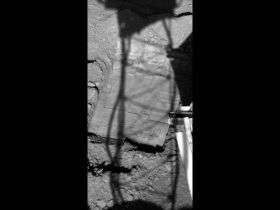
NASA's Phoenix Mars Lander is enlarging a trench informally named "Snow White" to prepare a cleaned-off area at the top of a subsurface layer of hard material, possibly ice-rich soil. Image credit: NASA/JPL-Caltech/University of Arizona

NASA's Phoenix Mars Lander is using its Robotic Arm to enlarge an exposure of hard subsurface material expected to yield a sample of ice-rich soil for analysis in one of the lander's ovens.

The trench was about 20 by 30 centimeters (8 by 12 inches) after work by the arm on Saturday. The team sent commands today to extend the longer dimension by about 15 centimeters (6 inches).

Experiments with a near-duplicate of the lander in Tucson during the past week indicate that the bigger surface is needed to allow steps planned for collecting an icy sample from the Martian trench informally named "Snow White."

"Right now, there is not enough real estate of dark icy soil in the trench to do a sample acquisition test and later a full-up acquisition" for the Thermal and Evolved-Gas Analyzer, said Ray Arvidson, Phoenix's "dig czar," from Washington University in St. Louis. The arm's rasp will kick the icy soil into the scoop through a special capture mechanism, and scientists also want to scoop up any loose material left in the trench from the rasping activity, Arvidson said.

Samples of shallower, non-icy soil from the Snow White trench have already been examined in Phoenix's wet chemistry laboratory and optical microscope, and a fork-like probe has checked how well nearby soil conducts electricity and heat.

"The Phoenix science team is working diligently to analyze the results of the tests from these various instruments," said Phoenix principal investigator Peter Smith. "The preliminary signatures we are seeing are intriguing. Before we release results, we want to verify that our interpretations are correct by conducting laboratory tests."

As the Robotic Arm was extracting the fork-like conductivity probe from the soil on Saturday, the arm contacted a rock called "Alice," near the "Snow White" trenching area. The arm is programmed to stop activity when it encounters an obstacle.

The team assessed the arm's status on Sunday and decided to resume use of the arm on Monday. Today's commands call for the Robotic Arm to move away from the rock, dump out soil that is in the scoop and extend the Snow White trench approximately 15 centimeters (6 inches) toward the lander.

Provided by NASA

Explore further: Cassini imaging lead hopes for planet-wide celebration of the Pale Blue Dot

add to favorites email to friend print save as pdf

Related Stories

Mars data published in Science this week

Jul 02, 2009

Four papers in the journal Science this week offer new details about the history of water on Mars, gleaned from the 2008 NASA Phoenix Mars Mission that was operated from The University of Arizona.

Phoenix Lander Winds Up Its Astonishing Summer On Mars

Nov 25, 2008

(PhysOrg.com) -- Mars has slipped far enough behind the sun today that signals from Mars-orbiting spacecraft are effectively blocked until mid-December. This solar conjunction happens every two years.

Phoenix Lander Finishes Soil Delivery to Onboard Labs

Oct 22, 2008

(PhysOrg.com) -- NASA's Phoenix Mars Lander has finished scooping soil samples to deliver to its onboard laboratories, and is now preparing to analyze samples already obtained. Scientists are anxious to analyze ...

Recommended for you

Super-hurricane-force winds on Venus are getting stronger

22 hours ago

(Phys.org) —As the closest planet to Earth, Venus is a relatively easy object to observe. However, many mysteries remain, not least the super-rotation of Venus' atmosphere, which enables high altitude winds ...

ExoMars 2016 set to complete construction

Jun 18, 2013

ESA's mission to Mars in 2016 has entered the final stage of construction with the signature of a contract today with Thales Alenia Space at the Paris Air & Space Show.

Australian team maps Moon's hidden craters

Jun 18, 2013

Australian scientists Tuesday said they had identified a possible 280 additional craters on the Moon, a finding they said could shed light on the history of the Earth's natural satellite.

User comments : 2

Adjust slider to filter visible comments by rank

Display comments: newest first

menkaur
1 / 5 (2) Jul 15, 2008
make it faster
out7x
1 / 5 (1) Aug 14, 2008
Still waiting for evidence of ice on mars.

More news stories

EUROnu project recommends building Neutrino Factory

(Phys.org) —The European Union's Seventh Framework Programme, EUROnu, has submitted its findings to a panel at CERN. Charged with choosing a project to study the nature of matter and antimatter, the project ...

Multiview 3-D photography made simple

Computational photography is the use of clever light-gathering tricks and sophisticated algorithms to extract more information from the visual environment than traditional cameras can.