How will the Arctic sea ice cover develop this summer?
Jul 09, 2008
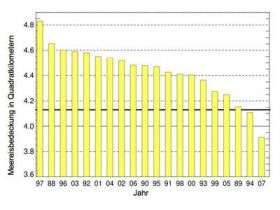
Simulated minimum sea-ice extent in 2008 when forced with atmospheric data from each year between 1988 and 2007 from the initial state of June 27, 2008. Model derived ice extents have been adjusted with a constant offset to account for discrepancies with satellite-derived ice extents. The thick black horizontal line displays the yearly minimum ice extent from 2007. Credit: Alfred Wegener Insitute

The ice cover in the Arctic Ocean at the end of summer 2008 will lie, with almost 100 per cent probability, below that of the year 2005 – the year with the second lowest sea ice extent ever measured. Chances of an equally low value as in the extreme conditions of the year 2007 lie around eight per cent. Climate scientists from the Alfred Wegener Institute for Polar and Marine Research in the Helmholtz Association come to this conclusion in a recent model calculation.

They participate with their prognosis in an international scientific contest, in which some of the most renowned institutes on climate research want to fathom out possibilities for seasonal predictions on Arctic sea ice cover by means of different methods and climate models.

"After the strong decrease of the Arctic ice during the last summer, climate scientists all around the world are constantly asked: how will the ice develop in the next years?" describes Prof. Dr. Rüdiger Gerdes from the Alfred Wegener Institute his motivation. "To answer this question, we did not want to guess, but to rely on sound calculations."

The scientists' problem: scenarios of the long-term development of sea ice clearly indicate a de-creased ice cover - exact prognoses for the following summer, however, are not yet possible. This is mainly due to the fact that the short-term development of sea ice depends strongly on the actual atmospheric conditions, namely the weather and in particular wind, cloud cover and air temperatures.

Because the exact atmospheric conditions which determine the weather patterns in the Arctic Ocean during the coming months are not predictable, Rüdiger Gerdes and his team have entered atmospheric data of the last twenty years into an ocean sea ice model developed at the Alfred Wegener Institute.

"Through this, we are still not able", says Gerdes, "to make a definitive statement on sea ice cover in September. However, this 'trick' enables us to compute the bandwidth of possible ice covers, and to quantify the probability of extreme events." Apart from the variability of atmospheric quantities during the melting season, ice thickness at the beginning of the season determines the new ice minimum. Accordingly, computations of ice thickness enter the models of the researchers from Bremerhaven. Start conditions from June 27th 2008 were used for their current prognosis.

Different from long-term prognoses, the researchers' forecasts can quickly be checked by reality. This is all right by Rüdiger Gerdes and his team. "It is a first test, and all participating researchers are eager to know how their prognosis has fared at the end of the summer. In the end, this small competition serves the optimisation of our models, so that we are able to improve our predictions concerning short-term seasonal fluctuations. It has to be added, however, that even perfect models would not be able to rule out a component of chance regarding the atmosphere. These forecasts will always be about probability, and not exact prognoses."

Source: Helmholtz Association of German Research Centres

Explore further: Long-term warming, short-term variability: Why climate change is still an issue

add to favorites email to friend print save as pdf

Related Stories

German energy shift faces headwinds

May 19, 2013

Tense engineers have their eyes peeled on complex colour-coded diagrams on a wall-sized screen that makes their control room look like the inside of a spaceship.

Mars Icebreaker Life mission

May 16, 2013

Missions to Mars have only scratched its surface. To go deeper, scientists are proposing a spacecraft that can drill into the Red Planet to potentially find signs of life.

Recommended for you

NASA's BARREL mission launches 20 balloons

7 hours ago

(Phys.org) —In Antarctica in January, 2013 – the summer at the South Pole – scientists released 20 balloons, each eight stories tall, into the air to help answer an enduring space weather question: ...

Power of US tornado dwarfs Hiroshima bomb

8 hours ago

Wind, humidity and rainfall combined precisely to create Monday's massive killer tornado in Oklahoma. The awesome amount of energy released dwarfed the power of the atomic bomb that leveled Hiroshima.

Origins of human culture linked to rapid climate change

15 hours ago

Rapid climate change during the Middle Stone Age, between 80,000 and 40,000 years ago, during the Middle Stone Age, sparked surges in cultural innovation in early modern human populations, according to new research.

User comments : 5

Adjust slider to filter visible comments by rank

Display comments: newest first

mikiwud
2.8 / 5 (4) Jul 10, 2008
Don't these people read any other "research" than their own? There have been large volcanoes erupting under the Arctic sea ice in recent years,at least pay lipservice to factoring it into your deliberations.
GrayMouser
4.3 / 5 (3) Jul 10, 2008
It makes a nice graph but I don't understand why it isn't in chronological order instead of jumping around.
Glis
2.3 / 5 (3) Jul 12, 2008
It makes a nice graph but I don't understand why it isn't in chronological order instead of jumping around.


Good call. 01-04,06 were all pretty thick. What a sleazy way to manipulate data!
Excalibur
2.3 / 5 (3) Jul 16, 2008
The data are not manipulated, but ranked by magnitude for ease of comparing by that value, not by time. Thus, those years which show the greatest deviation are most easily identified.
Glis
1 / 5 (2) Jul 17, 2008
No, it's just plain misleading.

The title is about how will it develop THIS SUMMER. You expect a graph that will allow you to forecast the next year, but a graph that doesn't have a chronological time axis is near useless.

More news stories

NASA's BARREL mission launches 20 balloons

(Phys.org) —In Antarctica in January, 2013 – the summer at the South Pole – scientists released 20 balloons, each eight stories tall, into the air to help answer an enduring space weather question: ...

Power of US tornado dwarfs Hiroshima bomb

Wind, humidity and rainfall combined precisely to create Monday's massive killer tornado in Oklahoma. The awesome amount of energy released dwarfed the power of the atomic bomb that leveled Hiroshima.

If you can remember it, you can remember it wrong

(Medical Xpress)—Native peoples in regions where cameras are uncommon sometimes react with caution when their picture is taken. The fear that something must have been stolen from them to create the photo ...

Encouraging signs for bee biodiversity

Declines in the biodiversity of pollinating insects and wild plants have slowed in recent years, according to a new study. Researchers led by the University of Leeds and the Naturalis Biodiversity Centre in the Netherlands ...

B vitamins could delay dementia

(Medical Xpress)—Despite spending billions of dollars on research and development, drug companies have been unable to come up with effective treatments for dementia and Alzheimer's Disease (AD). Now, A. ...