Toward long-range beach forecasts on bacterial contamination
Jun 30, 2008
Toward long-range beach forecasts on bacterial contamination
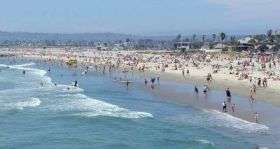
Scientists are reporting development of a water quality prediction method so that vacationers can better plan beach holidays. Courtesy of public-domain-photos.com

Long-range forecasts of beach bacterial contamination are inching closer to reality because of a new water quality prediction method scheduled for publication in the July 15 issue of the ACS' Environmental Science & Technology.

"For the first time, this study showed that bacteria concentrations could be forecasted with reasonable accuracy, hastening the day when people will be able to better plan their beach holidays," the report says.

In the new study, Walter E. Frick and colleagues explain that decisions on whether beaches are safe for swimming, or should be closed due to fecal contamination, are based on testing the water for E. coli.

However, existing tests take 24 hours to complete, providing a backward-only look at conditions the previous day. As a result, beaches may be closed unnecessarily when water quality has improved, or open when water quality has declined and disease-causing microorganisms are present.

Building on pioneering modeling studies in the Great Lakes by the U. S. Geological Survey (USGS) and others, the researchers developed "Virtual Beach," a broadly-applicable software tool for the development of models that predict concentrations of indicators of fecal contamination at beaches.

Unique features of Virtual Beach are the ability to evaluate a dynamic modeling approach for using short-term data sets to rapidly develop reliable models, and the use of available weather and marine forecast variables to forecast E. coli levels 24 hours or more in advance.

Evaluations of Virtual Beach were accomplished using data collected by USGS, NOAA and other sources for Huntington Beach on Lake Erie in northeastern Ohio. During the 42-day study, models developed by Virtual Beach correctly forecasted 24 hours in advance eight instances when E. coli levels exceeded safety standards. These results exceeded the accuracy of traditional sampling methods and approximately matched the accuracy of nowcasting (real-time predictions), according to the researchers.

Source: ACS

Explore further: Chinese, Indian airlines face EU pollution fines

add to favorites email to friend print save as pdf

Related Stories

Encroaching sea already a threat in Caribbean

May 07, 2013

The old coastal road in this fishing village at the eastern edge of Grenada sits under a couple of feet of murky saltwater, which regularly surges past a hastily-erected breakwater of truck tires and bundles ...

Seaweed under the roof

Mar 07, 2013

For many coastal dwellers, seaweed washed up on the shore is nothing but a nuisance. But this raw material has proven itself capable of keeping buildings well insulated. Together with industry partners, researchers ...

Recommended for you

Chinese, Indian airlines face EU pollution fines

15 hours ago

Eight Chinese and two Indian airlines face fines of up to several million euros for not paying for their greenhouse gas emissions during flights within the bloc, the European Commission said on Friday.

Fracking risks to ground water assessed

May 17, 2013

(Phys.org) —Extraction of "unconventional" gas from sedimentary rocks such as shale could provide a clean energy source and help some regions to become energy independent, but concerns have been raised ...

Caribbean talks conservation on Branson's island

May 17, 2013

(AP)—Surrounded by a turquoise sea and a menagerie of exotic animals on a billionaire's private island, political and business leaders gathered Friday to back an initiative aimed at expanding protection ...

User comments : 0

More news stories

Galaxy's Ring of Fire

Johnny Cash may have preferred this galaxy's burning ring of fire to the one he sang about falling into in his popular song. The "starburst ring" seen at center in red and yellow hues is not the product of ...

Alaska volcano shoots ash 15,000 feet into the air

(AP)—One of Alaska's most restless volcanoes has shot an ash cloud 15,000 feet into the air in an ongoing eruption that has drawn attention from a nearby community but isn't expected to threaten air traffic.

Chinese, Indian airlines face EU pollution fines

Eight Chinese and two Indian airlines face fines of up to several million euros for not paying for their greenhouse gas emissions during flights within the bloc, the European Commission said on Friday.

Morocco to harness the wind in energy hunt

Morocco is ploughing ahead with a programme to boost wind energy production, particularly in the southern Tarfaya region, where Africa's largest wind farm is set to open in 2014.

US seizes Bitcoin operator accounts

US authorities seized the accounts of a Bitcoin digital currency exchange operator, claiming it was functioning as an "unlicensed money service business," court documents showed Friday.