Active submarine volcanoes found near Fiji
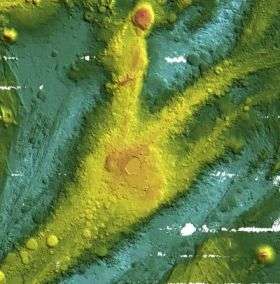
Several huge active submarine volcanoes, spreading ridges and rift zones have been discovered northeast of Fiji by a team of Australian and American scientists aboard the Marine National Facility Research Vessel, Southern Surveyor.
On the hunt for subsea volcanic and hot-spring activity, the team of geologists located the volcanoes while mapping previously uncharted areas. Using high-tech multi-beam sonar mapping equipment, digital images of the seafloor revealed the formerly unknown features.
The summits of two of the volcanoes, named 'Dugong', and 'Lobster', are dominated by large calderas at depths of 1100 and 1500 metres.
During the six-week research expedition in the Pacific Ocean, scientists from The Australian National University (ANU), CSIRO Exploration & Mining and the USA, collaborated to survey the topography of the seafloor, analysing rock types and formation, and monitoring deep-sea hot spring activity around an area known as the North Lau Basin, 400 kilometres northeast of Fiji.
The voyage's Chief Scientist, ANU Professor Richard Arculus describes the terrain – the result of extreme volcanic and tectonic activity – as spectacular. "Some of the features look like the volcanic blisters seen on the surface of Venus," he says.
"These active volcanoes are modern day evidence of mineral deposition such as copper, zinc, and lead and give an insight into the geological make-up of Australia," he says.
"It provides a model of what happened millions of years ago to explain the formation of the deposits of precious minerals that are currently exploited at places like Broken Hill and Mt Isa. It may also provide exploration geologists with clues about new undiscovered mineral deposits in Australia.
"These deep-sea features are important in understanding the influences that have shaped not only our unique continent but indeed the whole planet," Professor Arculus says.
Such discoveries highlighted man's lack of knowledge about the world's oceans. "We know more about the surface of Mars than we know about the ocean seafloor," Professor Arculus says.
CSIRO's Director of Research Vessels, Captain Fred Stein, says the expedition was a humbling experience. "It was a reminder that at the beginning of the 21st century it is still possible – on what is often regarded as a thoroughly explored planet – to discover a previously unknown massif larger than Mt Kosciuszko," he says.
"We are fortunate that we can offer the scientific capability of the Southern Surveyor to Australian scientists. It's the only Australian research vessel that can provide the opportunity to conduct such valuable research to make these kinds of discoveries possible."
Source: CSIRO Australia


