Freshwater runoff from the Greenland Ice Sheet will more than double by the end of the century
Jun 12, 2008
East Greenland Runoff
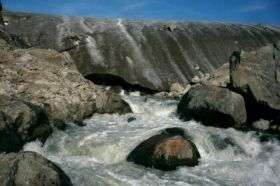
Freshwater runoff in East Greenland, Mittivakkat Glacier, Ammassalik Island in 2005. Credit: Sebastian H. Mernild

The Greenland Ice Sheet is melting faster than previously calculated according to a recently released scientific paper by University of Alaska Fairbanks researcher Sebastian H. Mernild.

The study, published in the journal Hydrological Processes, is based on models using data from the Intergovernmental Panel on Climate Change, as well as satellite images and observations from on the ground in Greenland.

Mernild and his team found that the total amount of fresh water projected to flow from the Greenland Ice Sheet into the North Atlantic Ocean from 2071 to 2100 will be more than double current levels.

Today, the East Greenland Ice Sheet adds 257 cubic kilometers of fresh water to the ocean per year from both melting and iceberg calving. By 2100, those levels are estimated to reach 456 cubic kilometers per year. With land-based runoff factored in, the total fresh water flowing from Greenland into the ocean is estimated to increase from 438 cubic kilometers to 650 cubic kilometers by 2100. The projected increase means that rather than rising at a rate of 1.1 millimeters per year, sea levels would rise by 1.6 millimeters per year.

"The Greenland Ice Sheet mass balance is changing as a response to the altered climatic state," said Mernild. "This is faster than expected. This affects freshwater runoff input to the North Atlantic Ocean and plays an important role in determining the global sea level rise and global ocean … circulation."

Mernild is conducting the research as part of the University of Alaska's International Polar Year efforts. He was appointed a University of Alaska IPY postdoctoral fellow by UA president Mark Hamilton in 2007.

Source: University of Alaska Fairbanks

Explore further: The mammoth's lament: Study shows how cosmic impact sparked devastating climate change

add to favorites email to friend print save as pdf

Related Stories

Ice-free Arctic may be in our future, says research

May 09, 2013

Analyses of the longest continental sediment core ever collected in the Arctic, recently completed by an international team led by Julie Brigham-Grette of the University of Massachusetts Amherst, provide ...

Encroaching sea already a threat in Caribbean

May 07, 2013

The old coastal road in this fishing village at the eastern edge of Grenada sits under a couple of feet of murky saltwater, which regularly surges past a hastily-erected breakwater of truck tires and bundles ...

Recommended for you

Slow earthquakes: It's all in the rock mechanics

6 hours ago

(Phys.org) —Earthquakes that last minutes rather than seconds are a relatively recent discovery, according to an international team of seismologists. Researchers have been aware of these slow earthquakes, ...

Cracking the ice code

11 hours ago

(Phys.org) —What happened the last time a vegetated Earth shifted from an extremely cold climate to desert-like conditions? And what does it tell us about climate change today?

User comments : 2

Adjust slider to filter visible comments by rank

Display comments: newest first

Ninderthana
1.8 / 5 (5) Jun 13, 2008
This is science reporting at its absolute worst.
The assumption of this article is that world temperatures will heat up over the next century because of man-made CO2 in the atmosphere.

This is an unproven scientific hypothesis, yet it is taken as Gospel by pseudo-scientist that wrote this article.

When will people in the media stop basing alarmist predictions on wild scientific speculation.

An article like this just degrades the scientific method.
rubberman
3 / 5 (4) Jun 13, 2008
You just commented on the scientific method, WHILE stating that the article makes an ASSUMPTION that isn't mentioned or even hinted at in the article. How scientific is that?

More news stories

Slow earthquakes: It's all in the rock mechanics

(Phys.org) —Earthquakes that last minutes rather than seconds are a relatively recent discovery, according to an international team of seismologists. Researchers have been aware of these slow earthquakes, ...

Unraveling the Napo's mystery

In the United States, rivers and their floodplains are well-documented and monitored. Ecuador's largest river, however, remains largely mysterious. Research led by Michigan State University is helping the ...

Practice makes perfect? Not so much

Turns out, that old "practice makes perfect" adage may be overblown. New research led by Michigan State University's Zach Hambrick finds that a copious amount of practice is not enough to explain why people ...

Lab sets a new record for creating heralded photons

(Phys.org) —Entanglement, by general consensus of physicists, is the weirdest part of quantum science. To say that two particles, A and B, are entangled means that they are actually two parts of an inseparable ...

Non-wetting fabric drains sweat

(Phys.org) —Waterproof fabrics that whisk away sweat could be the latest application of microfluidic technology developed by bioengineers at the University of California, Davis.