Medical research on ice
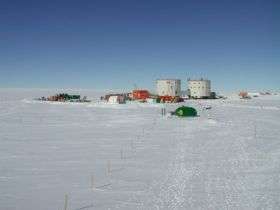
New medical equipment recently delivered to the Antarctic station Concordia will help understand how our bodies physically adapt to this extreme environment - knowledge which could help prepare for a future human mission to Mars. ESA is currently looking for a candidate with a medical background to support projects at the research base.
The Antarctic station Concordia is located in one of the most hostile environments on the Earth. Built on an ice plateau at 3 200 m altitude, exposed to extreme isolation, temperatures, constant light in summer, constant darkness in winter and other stressors, a stay at Concordia is a huge challenge.
Harsh winter
For the up to 16 crewmembers that can be hosted in the station during the Antarctic winter, conditions are even more severe as the harsh environmental conditions make access to or from the station impossible. Any problems that occur need to be dealt with autonomously by the crew with the resources at hand.
Fortunately for ESA, many of the same constraints that naturally occur during the winter at Concordia are quite similar to those that can be expected for future crewed exploration missions, for example to Mars.
For this reason, in 2002, ESA established a cooperation with the builders and operators of the station; the French Polar Institute (Institute Paul Emile Victor, IPEV) and the Italian Antarctic Programme (Consorzio per l'Attuazione del Programma Nazionale di Ricerche in Antartide, PNRA S.C.r.l.). Next to some technology validation, the main focus of this cooperation is on medicine, physiology and psychology.
Long-Term Medical Survey
Together with the Concordia partners and a diverse group of experts, ESA has defined the Long-Term Medical Survey (LTMS); a list of physiological and psychological parameters that is collected by each Concordia crewmember, with the goal of enhancing knowledge about human adaptation in this extreme environment.
To facilitate the collection of physiological data, ESA commissioned the development of an easy-to-use, minimally intrusive, integrated monitoring device, taking into account that the majority of Concordia crewmembers have no medical background. The first prototype was recently shipped to Antarctica and is now being evaluated by the Concordia crew.
Other interesting medical and psychological research is still ongoing at the station. For example, a current project investigates how blood clotting is affected by the high altitude at Concordia. This research is very relevant to understanding the 'economy class syndrome' - the risk of thrombosis when flying long-distance in airplanes. The psychological projects look for example at how the crew adapts to the extreme environment, or how they cope with the challenging situation. This type of research will also continue throughout the coming winter season.
Source: European Space Agency


