Report confirms drilling, not earthquake, caused Java mud volcano
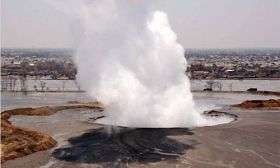
A two-year old mud volcano which is still spewing huge volumes of mud, has displaced more than 30,000 people and caused millions of dollars worth of damage was caused by the drilling of a gas exploration well, an international team of scientists has concluded.
The most detailed scientific analysis to date disproves the theory that an earthquake that happened two-days before the mud volcano erupted in East Java, Indonesia, was potentially to blame.
The report by British, American and Indonesian and Australian scientists is published this week in the academic journal Earth and Planetary Science Letters. It outlines and analyses a detailed record of operational incidents on the drilling of a gas exploration well, Banjar-Panji-1.
Lead author, Prof Richard Davies of Durham University, UK, published research in January 2007 which argued the drilling was most likely to blame for the eruption of the 'Lusi' mud volcano on May 29 2006.
This theory was challenged by the company that drilled the well and some experts who argued that the Yogyakarta earthquake two days before the eruption, which had an epicentre 250km from the mud volcano, was the cause.
Graduate student Maria Brumm and Prof Michael Manga of University of California, Berkeley undertook a systematic study to test the claims that the eruption was caused by this earthquake. They found that none of the ways earthquakes trigger eruptions could have played a role at Lusi.
Prof Michael Manga, of University of California, Berkeley, said: "We have known for hundreds of years that earthquakes can trigger eruptions. In this case, the earthquake was simply too small and too far away."
The new report concludes the effect of the earthquake was minimal because the change in pressure underground due to the earthquake would have been tiny. Instead, scientists are "99 per cent" certain drilling operations were to blame.
Prof Davies, of Durham University's Centre for Research into Earth Energy Systems (CeREES) explained: "We show that the day before the mud volcano started there was a huge 'kick' in the well, which is an influx of fluid and gas into the wellbore. We show that after the kick the pressure in the well went beyond a critical level."
"This resulted in the leakage of the fluid from the well and the rock formations to the surface – a so called 'underground blowout'. This fluid picked up mud during its accent and Lusi was born.
He said chances of controlling this pressure would have been increased if there was more protective casing in the borehole.
Prof Davies added: "We are more certain than ever that the Lusi mud volcano is an unnatural disaster and was triggered by drilling the Banjar-Panji-1 well."
Prof Manga added: "While this is a most unfortunate disaster, it will leave us with a better understanding of the birth, life and death of a volcano."
Lusi is still flowing at 100,000 cubic metres per day, enough to fill 53 Olympic swimming pools.
Recent research which Prof Davies was involved in showed it is collapsing by up to three metres overnight and could subside to depths of more than 140 metres, having a significant environmental impact on the surrounding area for years to come.
Citation: "The East Java Mud Volcano (2006 to Present): An Earthquake or Drilling Trigger?"; Davies, Richard J. et al, Earth and Planetary Science Letters.
Source: Durham University


