White Dwarf Lost in Planetary Nebula
Jun 03, 2008
White Dwarf Lost in Planetary Nebula
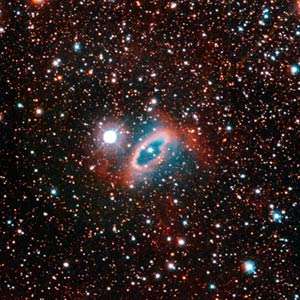
This image of the planetary nebula SuWt 2 reveals a bright ring-like structure encircling a bright central star. The central star is actually a close binary system where two stars completely circle each other every five days. The interaction of these stars and the more massive star that sheds material to create the nebula formed the ring structure. The burned out core of the massive companion has yet to be found inside the nebula. The nebula is located 6,500 light-years from Earth in the direction of the constellation Centaurus. This color image was taken on Jan. 31, 1995 with the National Optical Astronomy Observatory's 1.5-meter telescope at the Cerro Tololo Inter-American Observatory in Chile. Credit: NASA, NOAO, H. Bond and K. Exter (STScI/AURA)

Call it the case of the missing dwarf. A team of stellar astronomers is engaged in an interstellar CSI (crime scene investigation). They have two suspects, traces of assault and battery, but no corpse.

The southern planetary nebula SuWt 2 is the scene of the crime, some 6,500 light-years from Earth in the direction of the constellation Centaurus.

SuWt 2 consists of a bright, nearly edge-on glowing ring of gas. Faint lobes extend perpendicularly to the ring, giving the faintest parts of the nebula an hourglass shape.

These glowing ejecta are suspected to have been energized by a star that has now burned out and collapsed to a white dwarf. But the white dwarf is nowhere to be found.

The mystery deepened when researchers obtained ultraviolet observations in the early 1990's with NASA's International Ultraviolet Explorer satellite, expecting to see signs of a faint but very hot star. But no ultraviolet radiation was detected.

Instead, at the center of the nebular ring are two suspicious characters: a pair of tightly bound stars that whirl around each other every five days, neither one of which is a white dwarf. These stars are hotter than our Sun (their spectral class is A) but they are still not hot enough to make the nebula glow. Only a flood of ultraviolet radiation, such as that from the missing white dwarf, could do that.

The study is being conducted by Katrina Exter and Howard Bond of the Space Telescope Science Institute in Baltimore, Md. and a team of British and American colleagues. Their extensive photometry and spectroscopy of the binary show that both stars are larger than main-sequence stars of their masses. This may imply that they have started to evolve toward becoming red giants. Both stars also appear to be rotating more slowly than expected; they would be expected to always be facing the same sides toward each other, but they do not.

The astronomers suggest a simple explanation for the facts at the scene: the stars at the center of SuWt 2 were born as a family of three, with the A stars circling each other tightly and a more massive star orbiting further out. This allowed room for the massive star to evolve to become a red giant, which only then engulfed the pair of A stars. Trapped inside the red giant in what astronomers call a "common envelope," the pair spiraled down toward the core, causing the envelope to spin faster. Eventually, the outer layers of the red giant were ejected in the plane of the orbit, producing the ring-shaped nebula seen today. The unusually slow spins of the two A stars may have been another consequence of their victimization by their massive sibling.

The ground-based observations were obtained with telescopes at the Cerro Tololo Inter- American Observatory, Chile; the New Technology Telescope at the European Southern Observatory, Chile; the Anglo-Australian Telescope, Australia; and the South African Astronomical Observatory.

Ultraviolet radiation from the exposed hot core of the red giant would have caused the nebula to glow. If the giant's core were of high enough mass, it would then shrink and cool off rapidly to a faint white dwarf, which might explain its current invisibility.

Their results are being presented today at the 212th meeting of the American Astronomical Society in St. Louis, Mo. Other members of the team are Keivan Stassun (Vanderbilt University, Tenn.), Pierre Maxted and Barry Smalley (Keele University, UK), and Don Pollacco (Queen's University, UK).

Source: Hubble Center

Explore further: Three centaurs follow Uranus through the solar system

add to favorites email to friend print save as pdf

Related Stories

Snowden's life surrounded by spycraft (Update)

17 hours ago

In the suburbs edged by woods midway between Baltimore and Washington, residents long joked that the government spy shop next door was so ultra-secretive its initials stood for "No Such Agency." But when ...

Winners and losers at this week's E3

17 hours ago

Since the first battles over "Pong" machines in local arcades four decades ago, video gamers have loved good competition. And this year's Electronic Entertainment Expo—the industry's largest annual gathering—presented ...

Europe's space truck docks with ISS

17 hours ago

A robot freighter bearing 6.6 tonnes of cargo docked with the International Space Station (ISS) on Saturday, the European Space Agency (ESA) said.

Secret to Prism program: Even bigger data seizure

17 hours ago

In the months and early years after the Sept. 11, 2001, terrorist attacks, FBI agents began showing up at Microsoft Corp. more frequently than before, armed with court orders demanding information on customers.

Recommended for you

Three centaurs follow Uranus through the solar system

21 hours ago

Astrophysicists from the Complutense University of Madrid have confirmed that Crantor, a large asteroid with a diameter of 70 km has an orbit similar to that of Uranus and takes the same amount of time to ...

Final curtain for Europe's deep-space telescope

Jun 17, 2013

The deep-space telescope Herschel took its final bow on Monday, climaxing a successful four-year mission to observe the birth of stars and galaxies, the European Space Agency (ESA) said.

Hubble spots a very bright contortionist

Jun 17, 2013

(Phys.org) —The contorted object captured by Hubble in this picture is IRAS 22491-1808, also known as the South America Galaxy. It is an ultra-luminous infrared galaxy (ULIRG) that emits a huge amount of ...

Study explains decades of black hole observations

Jun 14, 2013

(Phys.org) —A new study by astronomers at NASA, Johns Hopkins University and Rochester Institute of Technology confirms long-held suspicions about how stellar-mass black holes produce their highest-energy ...

User comments : 0

More news stories

Dish won't submit revised bid for Sprint

Satellite TV operator Dish Network Corp. said Tuesday it would not submit a revised bid for Sprint, leaving the path open for the wireless carrier to accept what it already considers a superior offer from Japan's Softbank.

Cape Wind gets $200M investment from Danish fund

The Cape Wind offshore wind project has secured a $200 million investment from a Danish pension fund in what the wind farm's president said Tuesday is a milestone for the long-delayed project.